Welcome to the new website of “Iztok-Zapad” – quality books, knowledge, and inspiration all in one place!
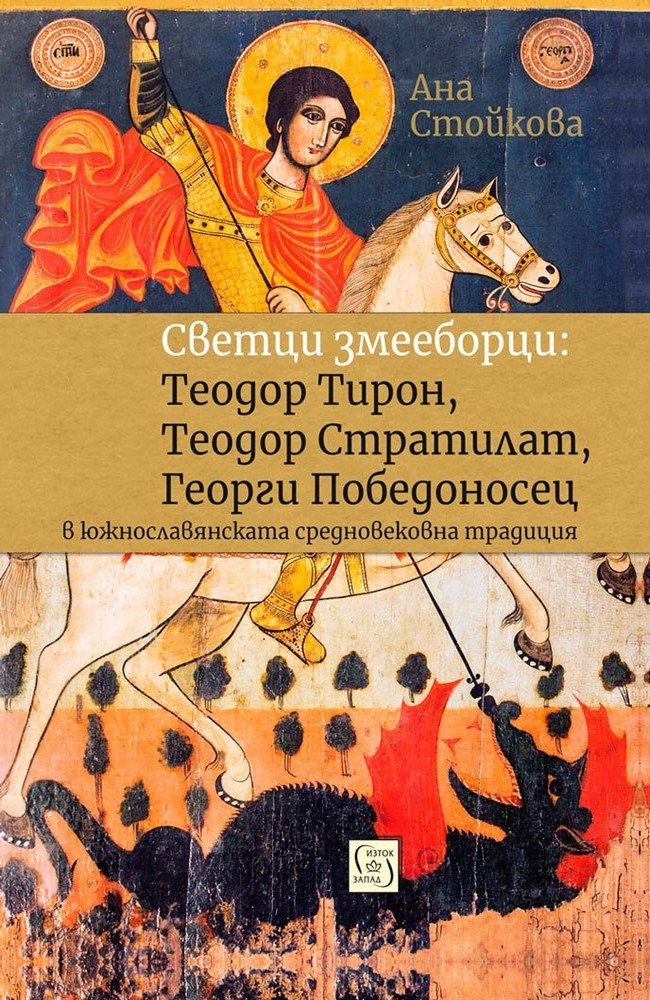
Dragon-Slayer Saints: Theodore Tiron, Theodore Stratelates and George the Victory-Bearer. South Slavic Medieval Tradition

Dragon-Slayer Saints: Theodore Tiron, Theodore Stratelates and George the Victory-Bearer. South Slavic Medieval Tradition

Sale -20%
  • 14.83€ / 29.00 лв.
  • 11.86€ / 23.20 лв.

Turn the Page. See the World: This month only, enjoy a 20% discount on all books.

Product Code:
2349-01
ISBN
978-619-01-0465-0
SKU
18.0254
Year
11-07-2019
Pages
336
Size
170/240 mm
Weight
0.51 kg
Cover Type
Hardcover
Genre
The Balkans & the Balkan countries, Byzantium, Bulgarian History, Middle Ages, Old Bulgarian Sources, Тheology, Christianity, Culturology, Folkloristics, Fine Arts

Ana Stoykova

Ana Stoykova

Ana Stoykova is Doctor of Sciences, PhD, Professor at the Institute of Literature at the Bulgarian Academy of Sciences, a researcher on medieval Slavic literatures. Her scholarly interests are in the field of Cyrillo-Methodian studies, hagiography and hagiology, textology, computer processing of medieval Slavic manuscripts. She is editor-in-chief of the the journal for Medieval Bulgarian literatur…
Read more

The victory over a dragon is a common motif in medieval hagiography, as well as in biblical and classical literature, and in folklore. Although traditionally associated with the Life cycle of St. George, the episode about the killing of a monster is part of the hagiographic narratives about two other well-known warrior-saints - St. Theodore Tiron and St. Theodore Stratelates. Indeed, as Ana Stoikova convincingly shows, the dragon-slaying episode is first attested among the miracles of St. Theodore Tiron. Later on, it strongly influenced the hagiographic tradition of St. Theodore Stratelates. In the Life of St. George it appears rather late, only after the 12th century. Stoikova summarizes the information about the cult of each of these three early Christian martyrs examining various historical, archaeological and iconographic sources. She makes a very concise overview of the emergence and interpretation of the dragon-slaying motif in Greek hagiographic, homiletic and hymnographic tradition about them outlining the time of its occurrence, its enrichment with additional elements, and its diffusion in various types of manuscripts, both as a part of the saint’s Life and as a self-standing miracle. Against this background, the South Slavic manuscript material is introduced.

There are no reviews for this product.