Add products and take advantage now.: This month only, enjoy a 20% discount on all books.
Product Code:
2777-01
ISBN
978-619-01-0814-6
SKU
15.0112
Year
22-04-2021
Translation
from English: Nikolay Vukov
Pages
336 + 8 pages color application
Size
140/215 mm
Weight
0.443 kg
Cover Type
Paperback
Genre
Researches, Scientific theories, Culturology
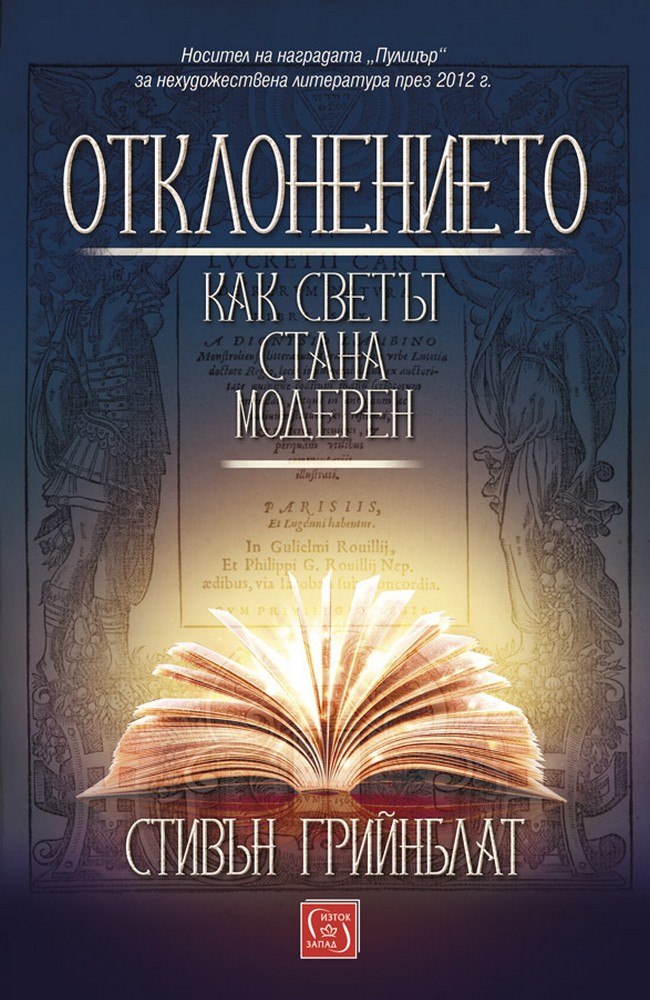
Stephen Greenblatt
Stephen Greenblatt is Cogan University Professor of the Humanities at Harvard University. He is the author of fourteen books, including Tyrant: Shakespeare on Politics; The Rise and Fall of Adam and Eve; The Swerve: How the World Became Modern; Shakespeare's Freedom; Will in the World: How Shakespeare Became Shakespeare; Hamlet in Purgatory; Marvelous Possessions; and Renaissance Self-Fashioning. …
Winner of the Pulitzer Prize for Nonfiction • Winner of the National Book Award • New York Times Bestseller
Renowned scholar Stephen Greenblatt brings the past to vivid life in what is at once a supreme work of scholarship, a literary page-turner, and a thrilling testament to the power of the written word.
In the winter of 1417, a short, genial, cannily alert man in his late thirties plucked a very old manuscript off a dusty shelf in a remote monastery, saw with excitement what he had discovered, and ordered that it be copied. He was Poggio Bracciolini, the greatest book hunter of the Renaissance. His discovery, Lucretius’ ancient poem On the Nature of Things, had been almost entirely lost to history for more than a thousand years.
It was a beautiful poem of the most dangerous ideas: that the universe functions without the aid of gods, that religious fear is damaging to human life, that pleasure and virtue are not opposites but intertwined, and that matter is made up of very small material particles in eternal motion, randomly colliding and swerving in new directions. Its return to circulation changed the course of history. The poem’s vision would shape the thought of Galileo and Freud, Darwin and Einstein, and—in the hands of Thomas Jefferson—leave its trace on the Declaration of Independence.
From the gardens of the ancient philosophers to the dark chambers of monastic scriptoria during the Middle Ages to the cynical, competitive court of a corrupt and dangerous pope, Greenblatt brings Poggio’s search and discovery to life in a way that deepens our understanding of the world we live in now.
“An intellectually invigorating, nonfiction version of a Dan Brown-like mystery-in-the-archives thriller.” — Boston Globe 16 pages of color illustrations
Don’t miss a thing! Subscribe to our newsletter and receive our latest articles, offers, and news directly in your inbox.
Cookie settings
We use cookies to provide you with the best possible experience. They also allow us to analyze user behavior in order to constantly improve the website for you.