
"Oil and Marble": A Captivating Tale of Michelangelo and Leonardo da Vinci
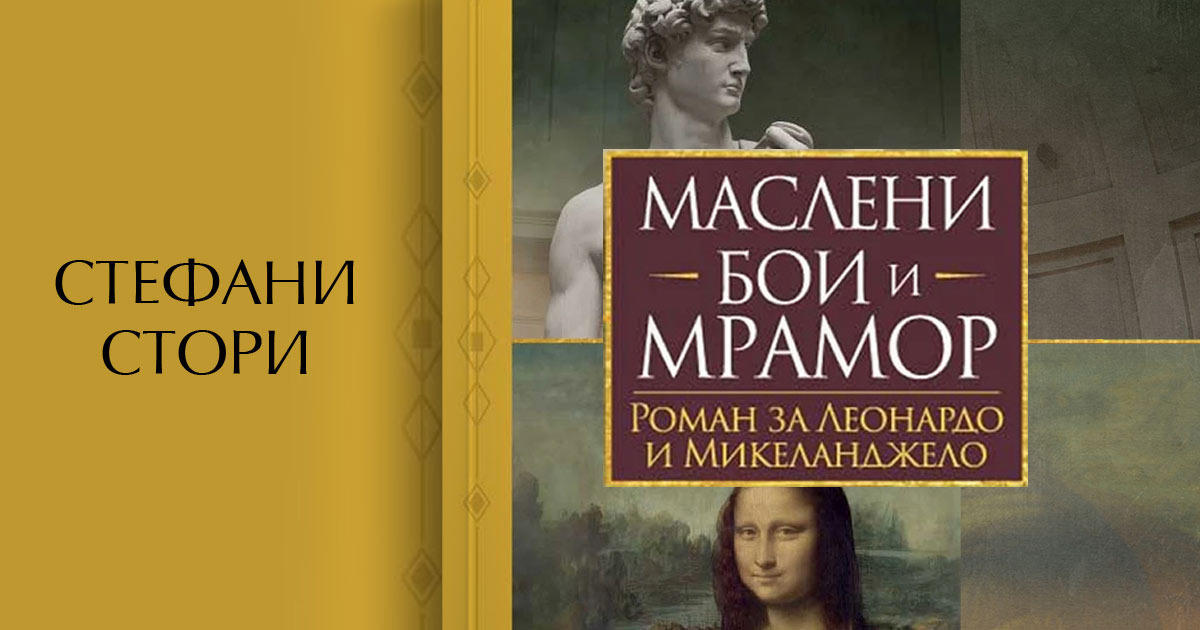
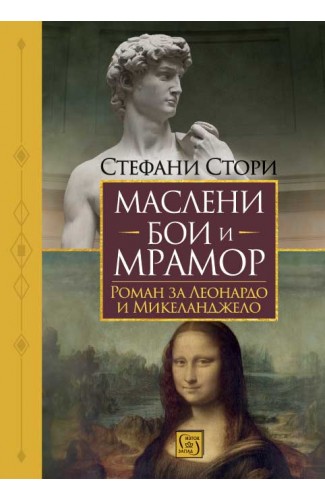
In human history, it is rare for two colossal geniuses to cross paths in the same city, at the exact same time, fueling their greatness with the fire of mutual animosity. Stephanie Storey’s debut novel, "Oil and Marble", transports us to the heart of Renaissance Florence between 1501 and 1505, making us witnesses to one of the greatest rivalries in art history.
The plot introduces us to a mature and refined Leonardo da Vinci—a fifty-year-old master wrapped in silk and glory, whose mind is a labyrinth of scientific insights and unfinished dreams. Standing against him is the young, unkempt, and passionate Michelangelo Buonarroti. Although he has already left behind his stunning Pietà in Rome, in Florence he is still perceived as a sculptor of uncertain potential.
The author masterfully describes how fate presents both men with a challenge in the form of the "Duccio Stone"—a massive block of marble considered irreparably damaged. While Leonardo proposes to "fix" it by adding new parts, Michelangelo sees within it the hidden spirit of David. With an audacity that catches many by surprise, the young sculptor wins the commission, embarking on a grueling process that will push him to the brink of physical and mental exhaustion.
While Michelangelo battles the marble, Leonardo passes through a period of severe personal and professional disappointments: from failed engineering projects to the bitterness of political games. In this dark moment, Lisa del Giocondo, the wife of a silk merchant, enters the stage. She becomes his inspiration, his quiet refuge. It is with her portrait that Da Vinci will seek the path to absolute perfection, creating the ultimate masterpiece, the Mona Lisa.
"Oil and Marble" reminds us that David and the Mona Lisa did not just appear out of nowhere; they were born in a city oversaturated with talent, where every chisel and brush strove to surpass what had already been achieved by Donatello, Verrocchio, and others. Storey turns reading into an intimate encounter with these titans, making us part of their world—a world where the pursuit of beauty was stronger than life itself.
The novel explores the eternal questions of a genius's loneliness, the fear of failure, and the unquenchable thirst for recognition. Storey shows us that behind the great masterpieces stand not icons, but human beings who love, suffer, and battle their own demons. The author consciously avoids the idealized, almost divine aura that history usually bestows upon great artists. In the narrative, there is no sentimentalism toward genius; the characters are presented as complex human personalities, each with their own moral or physical flaws. Storey builds a tense parallel between the two titans, revealing them not only through their greatness but also through their most unappealing sides. This lack of sentimentality makes the characters exceptionally vivid and authentic. Storey demonstrates that masterpieces are not born in a sterile environment but are the fruit of genuine human struggles—between a refined intellect that often makes moral compromises, and a raw passion that demands complete self-denial.
The particular merit of "Oil and Marble" lies in the fact that Stephanie Storey does not merely recount dry historical facts; she constructs complex, multi-layered psychological portraits of the two geniuses. It is this deep psychologism that makes the characters fleshed-out, three-dimensional, and incredibly resonant for the modern reader. The author guides us through the labyrinths of their minds, where creation is not an isolated act of applying paint or carving stone, but a painful reflection of their deepest inner searchings, crises, and shortcomings. In these portraits, Storey contrasts two fundamentally different human universes.
In the psychological profile of Da Vinci, the author captures the tragedy of a mind that is perhaps too vast. His primary quest is the pursuit of the absolute, divine order hidden behind natural phenomena. Leonardo, however, is paralyzed by his own perfectionism. Every new project of his begins with a grandiose idea, which his intellect immediately complicates to the point where it becomes impossible to execute in the material world. Storey shows us the vulnerability of the aging master, who hides his panic-stricken fear of mediocrity and of the rising new generation, embodied by Michelangelo, behind a mask of vanity and arrogance. His psychological salvation arrives only when, through Lisa del Giocondo, he learns to quiet his mind and allow pure emotion to guide his brush.
The portrait of Buonarroti is sculpted with entirely different strokes. His quest is not intellectual but sensory, almost religious. For Michelangelo, art is the ultimate form of self-denial. Psychologically, he is presented as a lone wolf who consciously flees society and human closeness to remain alone with the stone. His quest is the liberation of the spirit from the shackles of matter; he believes that the forms already exist within the marble, and his task is simply to bring them to light through the sacrifice of his talent. We see how behind his harsh, unwashed, and fiery character hides a fragile soul desperately seeking his father's approval and the recognition of Florence. His battle with the Duccio Stone is a psychological projection of his own fight with Goliath—with the doubt of whether his talent can triumph over Leonardo's elegance. It turns out that the two great works—for us, mere objects of aesthetic admiration—were not the fruit of placid inspiration, but of a dynamic, often destructive process in which their creators staked their very survival.
The author succeeds in recreating the spirit of the era with striking accuracy. The reader literally breathes in the scent of turpentine in Da Vinci's studio and feels the fine marble dust covering everything in Buonarroti’s workshop. Florence comes alive with its muddy streets, political intrigues, and majestic cathedrals. We encounter great figures of the era such as Niccolò Machiavelli and Cesare Borgia, adding further authenticity to the narrative.
Storey’s language is exceptionally captivating and vivid; she turns art history into a dynamic narrative that holds one's interest until the very last page. Her style authentically recreates not only the physical world of the Renaissance but also the intellectual clamor of the era. This was a time when genius was not a solitary phenomenon, but part of an ongoing dialogue between generations.
Stephanie Storey brought this story to life after 20 years of research. In addition to being a writer, she is a proven professional in the television industry, having produced shows such as The Alec Baldwin Show and the Emmy-nominated talk show The Writers' Room. The novel "Oil and Marble" has already been translated into several languages and is currently in development for a film adaptation.
Products related to this post
Comments