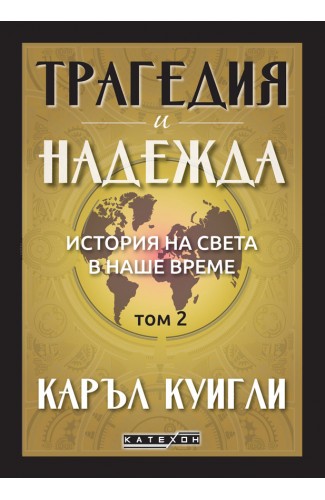
Carroll Quigley (1910-1977) was one of the most influential American historians, civilization theorists, and analysts of global political networks in the 20th century. He earned his PhD from Harvard University, where he also taught before establishing himself at the School of Foreign Service at Georgetown University. Quigley became a visionary in historical scholarship, applying a scientific and systemic approach to the study of the rise and fall of world empires, which made him an intellectual mentor to numerous world leaders, most notably President Bill Clinton.
Quigley's professional trajectory was marked by his roles as a consultant to the US Department of Defense, the Navy, and the Smithsonian Institution, where his expertise in the history of technology and institutional structures was highly valued. He is recognized as a pioneer of comparative civilizational history, offering an impartial and large-scale analysis of the hidden mechanisms of power and financial elites. In 1964, he was elected to the American Academy of Arts and Sciences, and his lectures at Georgetown remain legendary for their depth and foresight regarding contemporary geopolitical transformations.
Within the Iztok-Zapad Publishing House catalog, Carroll Quigley is featured through his monumental masterpieces, which form the core of modern historical and geopolitical thought:
- "Tragedy and Hope: A History of the World in Our Time" - A colossal work revealing the history of the 20th century through the lens of financial capitalism and international political networks;
- "The Evolution of Civilizations" - A fundamental theoretical study providing a unique model for the phases of growth and decay in human societies;
- "The Anglo-American Establishment" - An insightful analysis of secret circles of influence and their role in shaping global British and American foreign policy.
Today, Carroll Quigley's legacy continues to be a subject of intense study, grounded in the belief that understanding the past is the only key to predicting the future. His books are essential reading for anyone seeking to decipher the true levers of global governance and the complex architecture of the world order.