
“We discover that at the center of grief is a timeless love!”
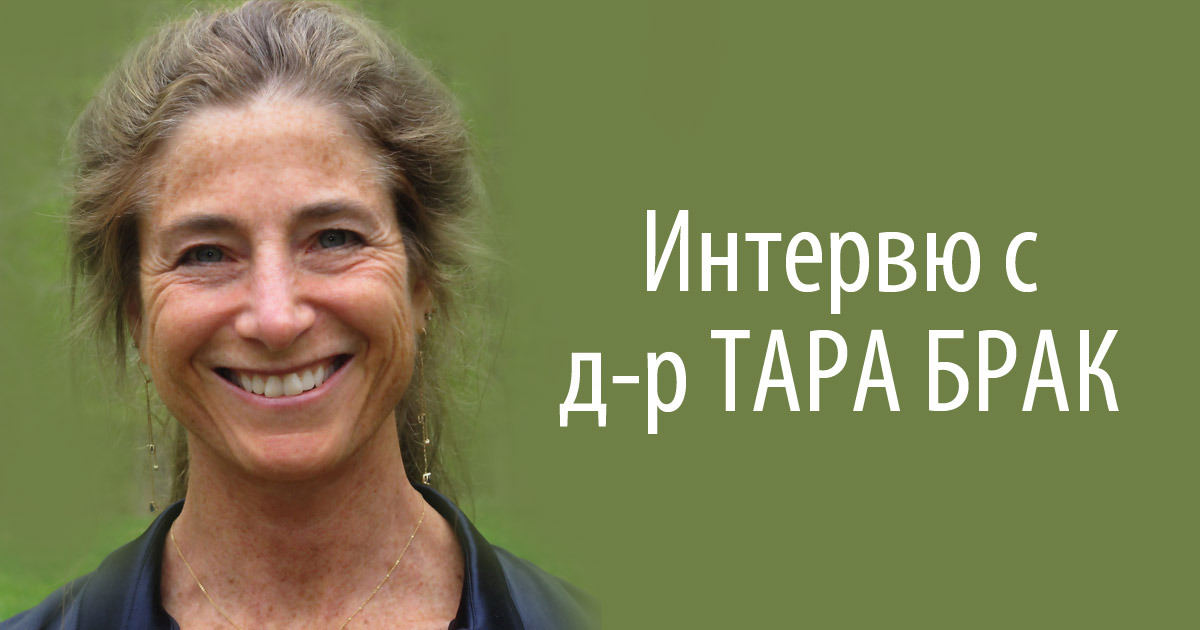 Interview with Dr. Tara Brach, author of “Radical Acceptance”
What is the inner truth you return to when everything else feels uncertain?
I turn to the loving awareness that is the source of our being – the mysterious presence that gives rise to this living, dying world. This is my true refuge: trusting in the timeless light and love that unites and holds all life.
Do you believe a person can ever free themselves from all their illusions, or is complete honesty with oneself an ideal we move toward but never fully reach?
My experience is that there are moments when we are free of illusion, and then quite naturally we contract again into varying degrees of trance. What matters is nurturing a sincere love for truth, a love for love itself. This aspiration gives us the energy, courage, and inspiration that awakens us to the reality that is our essence.
Where do you personally draw the line between genuine acceptance and quiet resignation, and how do you know when you’ve crossed it?
True acceptance and resignation are profoundly different states. If you check your body and heart, acceptance carries a quality of openness, lightness, and tenderness. It is an alignment with reality. Resignation, on the other hand, feels heavy and contracted, a shutting down of energy and spirit. Rather than aligning with reality, resignation is a reaction of pulling away from life.
Which moment in your life taught you the most about compassion?
I went through five years of a downward health trajectory. Initially I was distressed by the chronic pain and uncertainty, and blamed myself for not taking better care of myself. But when I learned to pause, face the fear and grief, and hold my own suffering with tenderness, I discovered the boundless heart of compassion. Opening to my own vulnerability allowed me to be touched more deeply by the reality of others’ suffering and, over time, to include widening circles of beings in a space of genuine care.
Do you see faith as an endless source of strength, or does it have seasons – moments when even the deepest well runs low?
Faith can sometimes feel out of reach because we humans are deeply conditioned to feel separate and vulnerable, and to perceive that “something is wrong.” Yet we also carry the evolutionary capacity to realize our belonging, our oneness, and to trust, in the deepest sense, that “all is well.”
Through our lives there may be seasons of doubt and fear, times when we are caught in the perception of a separate and threatened self. But the capacity for faith – for trusting reality – is always within us, and it can be nurtured so that remembrance arises in more and more moments.
We nurture faith by bringing a courageous unconditional presence to the life that is here. We nurture faith by engaging honestly and intimately with others, and by serving others. And we nurture it by consciously turning toward the beauty, goodness, love, and mystery that hold our lives.
If you could revisit one moment in your life with the awareness you have now, which would it be?
I can’t think of one particular moment. What comes to mind are the many moments when I saw and reacted to the masks—the surface expressions of others – and forgot the intrinsic goodness, the love and awareness that are our shared belonging.
Do we ever truly overcome our losses, or do we simply grow around them and learn to carry their weight differently?
If we meet loss with a full and intimate presence, we discover that at the center of grief is a timeless love. While the sorrow may remain throughout a lifetime, like waves moving through the sea, it no longer defines or takes over our life. Instead, we learn to hold our sorrow with great tenderness.
How do we recognize the moment when altruism stops being compassion and starts becoming self‑erasure?
Altruism becomes self-erasure when, in trying to care for others, we lose contact with our own inner life. Compassion is rooted in presence – it allows us to remain connected to our own heart and a space of equanimity, even as we respond to another’s suffering. But when helping becomes driven by fear, guilt, or the need to earn love or approval, there is a quiet abandoning of oneself.
Paradoxically, the more deeply we inhabit our own being, the more authentic and sustaining our care for others becomes. Real compassion is never based on disappearing; it arises from belonging to life, ourselves included.
Interview by Vladimir Tsankov
Products related to this post
Comments