
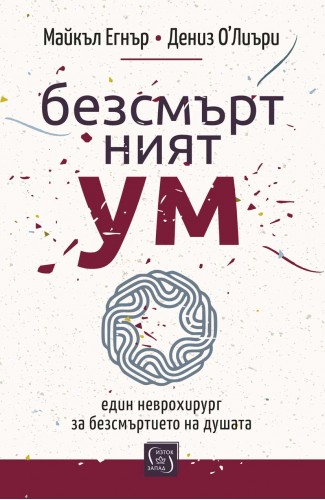
On the Metaphysics of the Mind – a review of "The Immortal Mind"
Recently, I published a review of the book “The Rise and Fall of the Human Mind” by Dr. Martin Jan Stránský, in which I shared that I am very drawn to research on how our brain functions. These days, I read another book on this exciting topic – “The Immortal Mind” by neurosurgeon Dr. Michael Egnor. While Stránský examines the functioning of the brain from a purely scientific perspective, Dr. Egnor does something different and completely unexpected from a doctor who has operated on thousands of brains: he deals, so to speak, with the metaphysics of the mind. His take on the subject leaves the operating room to shock us with the news that behind the functions of our brain, there is a part of us – our mind, which, in fact, does not need the brain all that much to exist.
Using many clinical examples, Dr. Egnor proves that there is an immortal part within us that continues to think, see, feel, and judge even in cases of severe brain damage or impairment. In a world dominated by the materialistic view that we are simply a "pile of neurons," Dr. Michael Egnor's book is remarkable—it is a spiritual lighthouse illuminating a space that few have had the chance to peer into. Drawing on his experience of over 7,000 brain surgeries, the author discovers that the human mind possesses a spiritual reality that cannot be fully explained by physical processes in the gray matter. He provides examples of patients where large parts of the brain were removed or damaged, yet their "self," their desires, and their reason remained intact.
One of the strongest arguments in the book relates to research on the "split brain." While the physical brain can be divided (and he has done so surgically), human consciousness maintains its unity—evidence that the soul is an indivisible and immaterial entity. Particularly compelling are the arguments regarding Near-Death Experiences (NDEs). The book shows that NDEs are not hallucinations, but real testimonies to the existence of consciousness beyond biological death.
As a theologian, for me, this book—written by a highly qualified practitioner—is an incredible testament that we are not merely biological machines doomed to decay, but spiritual beings with an eternal destiny. Dr. Egnor posits that the physical brain may be only a tool that limits and channels vast consciousness within the confines of earthly existence. And this changes everything—if the brain is a filter, then death is not the "switching off" of consciousness, but its release from the constraints of matter. By studying neurons, we are actually studying the "hardware" through which the "software" of the spirit manifests in our world. In fact, if you watch the presentation of Martin Jan Stránský's book, you will see that even he—in my view a convinced materialist and atheist—does not rule out the immortality of the mind, because it is already being undeniably proven by quantum physics. This is why Dr. Egnor's thesis is so relevant. But most importantly: it is truly comforting and inspiring when science supports the long-standing belief of the faithful that there is a consciousness within us that is immortal.

Ivinela Samuilova's review was published in the "What Are You Reading" (Kakvo chetesh) reader group.
Products related to this post
Comments