
A Story of the Depths Within: A Review of the Novel "Underwater"

I love books with depths—even metaphorical ones—where every step feels like a riddle. You never know where it might lead you: toward something beautiful and serene, or toward something dangerous and insurmountable.
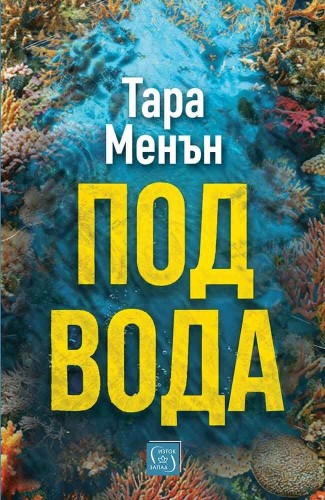
In her debut novel, Underwater, Tara Menon tells the story of two girls who meet as children. One of them, Marissa, has recently lost her mother. The other, Ariel, immediately offers: "Then come and share mine." Thus begins the miracle of childhood adventures—mischief and play, but also a profound sense of wonder and the audacity to explore the depths of the world, to see what lies beneath the deep water. There, quite literally, a new world exists—more attractive and perhaps even more orderly than our own.
Marissa’s parents are marine biologists. They named her after the sea—the thing they love most and which unites them. Ariel’s name is linked to the Archangel Ariel and the Hebrew tradition of the Lion of God, as she is as bold and fearless as a lioness. Yet, she is also the Ariel from the fairy tale of the Little Mermaid—beautiful and mysterious, yet stubborn and irresistible.
In exotic Thailand, where a research base for coral reef specialists is located on one of the islands, the girls join the marine researchers by simply diving in and exploring life underwater through the eyes of children. And what wonders await them! For instance, the manta rays, with their massive "devil" fins and intimidating proportions, turn out to be peaceful and wise observers. The children love to swim alongside them; they give them names and learn to recognize them. Most importantly, however, they learn to hold their breath underwater for as long as possible. Thus, the ocean, the sea, and the water become daily companions—friends. Or do they?
Up to this point in the narrative, nature and humanity communicate in relative harmony. I say relative because nature appears as a passive observer of its own grandeur. Man, on the other hand, despite his admiration, always seeks to extract something for himself—be it the killing of a manta ray, the felling of a tree, or a fuel leak into the ocean. The author’s perspective on every event in the novel is consistently ecological. She experiences, understands, and interprets each moment as a protector whose life depends on the survival of this natural world. This is to her credit, as she fights not only for herself but for her entire generation.
It is interesting that from a very tender age, the heroines learn to value the autonomy of nature; it becomes their companion, helper, and friend. Nature cradles them, prepares them, and warns them of the more serious events approaching.
Tara Menon divides the novel's timeline into two zones—centered around the 2004 tsunami that devastated Thailand and Hurricane Sandy, which struck New York in 2012. I am struck by her attention to detail and the sensitivity with which she visualizes the catastrophe’s dynamics and rhythm, as if observing it from above. Yet, her heroines are inside the apocalypse, enduring their fate to the very bottom.
There is much beauty in this novel, but also much pain. The victims of the tsunami are many, and their loved ones struggle to identify them. This time, the author enters the tragedy vertically, emphasizing the lightning-fast transformation of survivors from terror-stricken beings into efficient, thinking, and selfless people.
After the disaster, Marissa changes. She cannot, and will not, distinguish between life and death. She searches for her identity. She almost manages to recover, but still lacks the strength to overcome the memories that haunt her. Eight years later, she is in New York when, along with the rest of the city's residents, she experiences the impact of Hurricane Sandy. The personal drama seems to repeat itself. But this time, the heroine is spared the sudden shock; she is prepared for the disaster. Life and death are not separated by a falling curtain of water; they are huddled together under the dim shroud of the incessantly falling rain. She must choose her destiny and learn to navigate it as much as possible in reality, rather than in the clouds of mystification. Tara Menon reveals the transformation of Marissa’s character with exceptional mastery. In the end, we see her having found herself, in harmony with life and nature, enriched with more understanding and wisdom—grown up.
I believe this book would bring pleasure to all kinds of readers. First, to those who wish to feed their senses—with the searing fire of events, the fragrance of plants, or the taste of dishes—because the author's language, as writer Katie Kitamura says, is "so beautiful that it feels as if every sentence contains the whole world."
But this book is also for readers who seek something more—such as a profound respect for nature and the sciences aimed at its preservation (Tara Menon’s knowledge of flora and fauna is impressive). She herself defines her book as a "nature novel." In fact, she always places nature on equal footing with science, and I think this is one of the novel's greatest qualities.
Tara Menon is a young author with a rich biography. Born in India but raised in Singapore, she was educated in New York and earned her PhD from Columbia University. She has contributed to prominent publications like The New York Times. Currently, she teaches English at Harvard University. Her academic work lies in the fields of English literature and literary theory.
Author: Valentina Dicheva
Products related to this post
Comments