
I Like to Write About Ordinary People – Those Full of Hidden Treasures
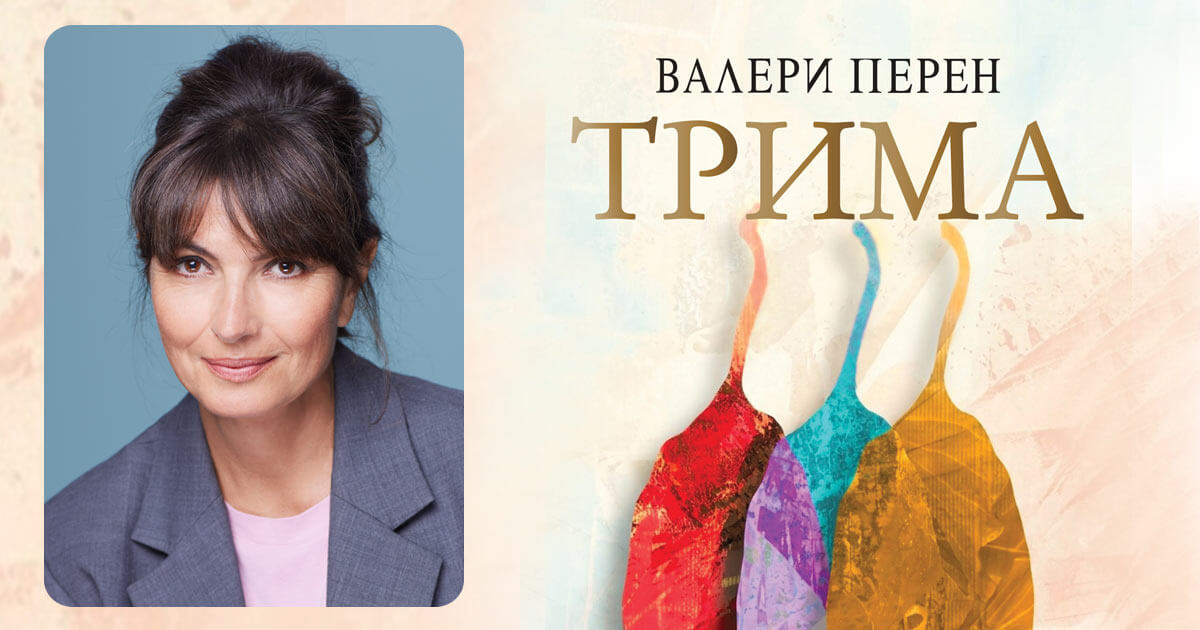
An Interview with Valérie Perrin, Author of "Throis"
You’ve acknowledged that the success
of “Changer l’eau des fleurs” inevitably created a great deal of pressure
around your next novel. What gave you the confidence that the story in “Trois”
was the one you wanted to tell as your third book?
I had already written about thirty pages.
My daughter came over to pick something up, and I said to her, “Listen,
sweetheart, I’m under so much pressure. I’ve started my new novel, and I’d like
to read you the first thirty pages because I’m not sure about it anymore. I
feel like Violette (the protagonist of Changer l’eau des fleurs) is
still taking up all the space.”
My daughter sat down next to me, and I
read her the first thirty pages of Trois. When I finished, she said,
“Mum, you can forget about Violette. Your writing is amazing. Just keep going.”
I think that day she gave me the push I
needed to write Trois exactly the way I wanted to – and dreamed of – writing
it.
Reviews often describe “Trois” as
emotionally profound and structurally intricate – “a quiet epic of friendship
and buried truths,” “a portrait of friendship that is both nostalgic and
brutally honest.” Many writers say that the reader’s response is ultimately
what matters most, yet I’m curious: was there a particular piece of literary
criticism that made you feel you had succeeded once again?
In France, there is a literary television
programme called La Grande Librairie. For many years, it was hosted by a
renowned literary journalist named François Busnel. It is a weekly live
television programme watched by people who are passionate about literature.
In 2021, I arrived backstage to take part
in the programme. It was my first time appearing on the show, and François
Busnel came into my dressing room to tell me how much he loved my novel. He
said to me, “Valérie, your book is magnificent, incredibly profound. I loved
it.”
I was absolutely terrified at the thought
of doing the programme live, but he immediately put me at ease and was
incredibly kind and supportive. I will never forget it.
You’ve said that “Trois” is, among
other things, an exploration of friendship across decades – precisely because
friendship often is chaotic and ever‑changing, shaped by the ways people grow
apart as life unfolds. Did you ever find yourself looking back at your own past
with a certain tenderness or melancholy while writing this story?
The people closest to me say that Trois
is my most personal novel. I think I am in each of the characters. I am
Étienne, Nina, Adrien and Virginie. I am their youth, their doubts, their
loves, their fears, their joys, their sorrows, their memories, their lies,
their melancholy.
The same goes for the novel’s soundtrack:
it’s my own soundtrack.
One of the most beautiful definitions
of storytelling says: “When people told themselves their past with stories,
explained their present with stories, foretold the future with stories, the
best place by the fire was kept for the storytellers.” Around which listeners
at that fire would you choose to tell “Trois”?
Trois
is a novel that speaks to people of all ages, to everyone’s own life stories.
So I would tell it to anyone who wants to hear it. To those who would like to
listen to me. I would rather let the audience choose me than the other way
around. My door is open to everyone.
Your novel is often described as a
story about childhood promises colliding with adult reality – and about the
adults who spend their lives living with the consequences of choices made long
ago. Yet the world children inhabit today is profoundly different from the one
of forty, or even twenty years ago. What, in your view, remains timeless in the
world of children – and can we, as adults, ever reclaim one of the purest
beliefs we once held, if we’ve lost it along the way: the belief that magic is
real?
I have
a very large family: seven wonderful stepchildren, nine wonderful
step-grandchildren, and two children of my own. I drew enormously on them when
writing Trois. By talking to the young people in my family, I realized
that they have exactly the same concerns I had at their age: Will the person I
love find me attractive? Will I know how to make love to them, how to kiss
them? Am I beautiful or handsome? What do I want to do with my life? What
career will I choose? Do my parents believe in me?
Despite
social media, despite the fact that children are exposed at an increasingly
young age–and it’s terrible – to pornographic images, completely crazy heads of
state, and climate change, setting all those considerations aside, the
fundamental questions of adolescence remain exactly the same.
And I dare to hope that our
teenagers still dream. But I believe they do. I have so much faith in young
people. Of course, it all depends on the country and the family you grow up in.
But dreams and hope have a place everywhere; they manage to find their way into
every corner.
You’ve often said that
you write about “invisible stories” – about people who carry secrets, pain, or
love that no one notices. You show a deep empathy for what you call “les petits
gens,” the people whose lives unfold quietly on the margins. Who are these
“small people” in Europe today? Those who struggle to fit into the demands of
modern life? Those who feel condemned to the solitude of virtual reality?
Immigrants – or, conversely, those who feel like strangers in their own
country?
The
question is far too broad. First of all, you have to find your place in life,
then find your own place within your family, at school, and later in the world
of work. In France, the minimum wage is around €1,200 a month. How can you
possibly live decently, with dignity, on so little when you have children? And
I’m not even talking about those who live in countries where there is no
minimum wage.
I’ve
just finished reading a magnificent novel by Thelizon Orelien about a refugee
who has to leave Haiti to save his life. Refugees don’t want to be refugees. No
one wants to be uprooted; they are saving their own lives and those of their
children. And yet they are often seen as a “problem” to be dealt with, to be
turned away.
And then, to come back to
my novels, I like to write about ordinary people who are full of hidden
treasures. Beautiful, terrible, detestable, endearing. Simply human. No
bling-bling.
You worked as a
professional photographer, and many readers explain the strong visual quality
of your writing – the attention to small details, the cinematic rhythm of your
scenes – through that experience. Do you ever feel tempted to explore new
tempos in the way you shape your stories, or to experiment with genres you
haven’t tried before?
I’m tempted to do it for my fifth novel.
However, structuring a story by alternating between the past and the present
may simply be part of my creative DNA. As for genre, perhaps a straight crime
novel, even though there is always an element of crime fiction in all my
novels, and particularly in Trois.
The film adaptation of “Changer l’eau
des fleurs”, directed by Jean‑Pierre Jeunet and currently in post‑production,
is expected to be released at the end of this year. What was your involvement
in the adaptation of your novel, and can we expect the same sensory richness
and emotional intensity that audiences associate with Jeunet’s earlier films,
such as “Amélie” and “Un long dimanche de fiançailles”?
Yes. I love
the way Jean-Pierre Jeunet talks about love and realistic poetry in his films,
and that is very much the case in Changer l’eau des fleurs.
To me,
the emotional intensity is present in every shot. He also preserved the humour
of the novel, and despite the various themes surrounding death, the film is
luminous and never lets sadness take over.
I didn’t take part in
writing the screenplay, but I had many conversations with Jean-Pierre while he
was working on the adaptation, particularly about Philippe Toussaint (the
protagonist’s missing husband), who is an extremely complex character.
You’ve mentioned “L’ombre du vent” by
Carlos Ruiz Zafón and “Les Déferlantes” by Claudie Gallay among your favourite
books. Which new titles have impressed you over the past year – and have you
rediscovered any older works that you would now add to your permanent list of
favourites?
I would
point out Toutes les nuances de la nuit by Chris Whitaker, Mal de
pierres by Milena Agus, L’œuvre de Dieu, la part du diable by
John Irving, Nous qui avons connu Solange by Marie Vareille, La
carte postale by Anne Berest, Charlotte by David Foenkinos, La
maison vide by Laurent Mauvignier and Je voulais vivre by
Adélaïde de Clermont-Tonnerre.
Interview by Vladimir Tsankov
Products related to this post
Comments