
"L'Ère de la flemme" and the End of Our Time
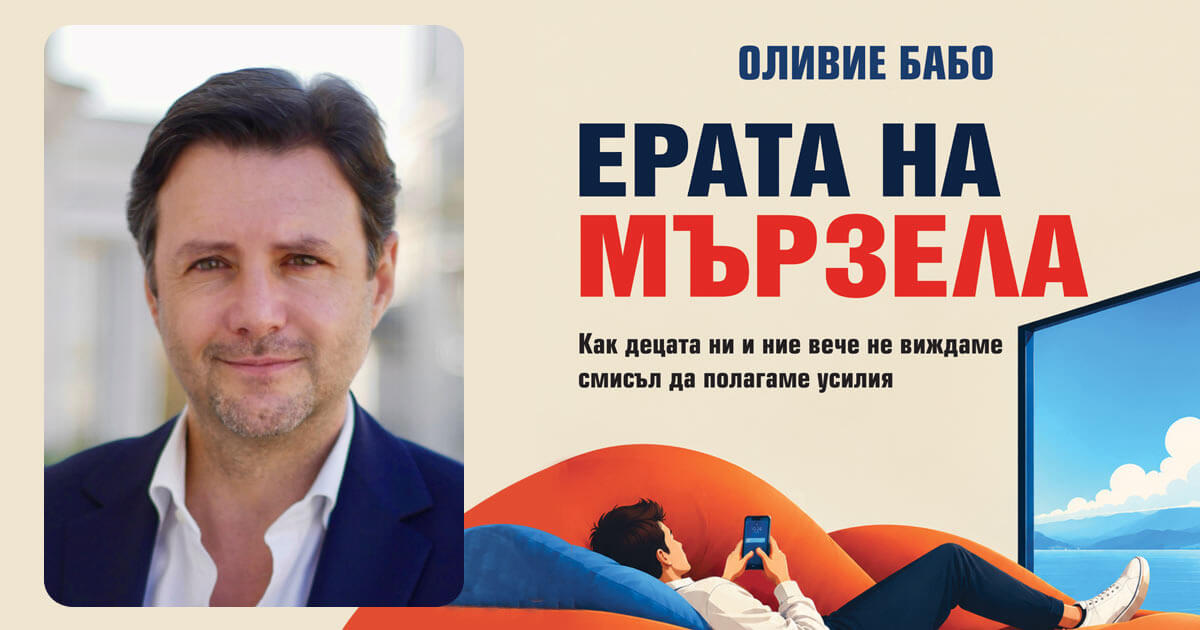 "L'Ère de la flemme" and the End of Our Time. Interview with prof. Olivier Babeau, author of “L'Ère de la flemme”
In the context of your book, how do you see the present moment: are we living in troubling times that demand immediate action, or are we already in the midst of a full-scale crisis?
I would say we are already in the midst of the crisis. We simply haven't named it properly yet. What I describe in the book is not a passing mood or a generational quirk, but a civilizational rupture. For the first time in human history, the three great challenges that have always structured our existence (surviving, belonging to a group, and fulfilling oneself) no longer require effort in the way they once did. Survival is guaranteed by the welfare state even for those who choose not to work. Belonging no longer demands that we conform to society; on the contrary, we now expect society to adapt to us. And self-realization has been reduced to the maximization of immediate pleasure. When these three locks fall away at once, something essential breaks in our relationship to effort. So no, I don't think we are merely "at risk." We are living through the crisis, in real time, and most of us haven't noticed because it doesn't look like a crisis. It looks like comfort.
Do you have a vivid memory of the first moment when you realized that the situation was truly serious?
It wasn't a single dramatic moment, but an accumulation of small, almost trivial observations that suddenly clicked into a pattern. I remember noticing, over the years, how even writing a short message had started to feel like a burden to people around me, how voice notes had replaced the effort of putting a thought into a sentence. Taken alone, that's nothing. But when you add to it the collapse of reading, the shrinking attention spans, the fact that a whole generation increasingly says "flemme" (can't be bothered) as a kind of badge rather than an embarrassment, you understand you're not looking at isolated symptoms. You're looking at a single underlying disease: the loss of the very idea that some things are worth the trouble. That was the moment I decided the subject deserved a book, not just a chapter. It was, moreover, the logical continuation of my previous book, The Tyranny of Entertainment, which analyzed the drift of our use of free time toward increasingly passive activities with no added human value.
We live in an era of ultra-processed food, TikTok-style content, and information pre-digested by AI. How can we explain to our children that all of this is easy to access, yet ultimately false and harmful?
I use the image of the "baba au rhum", that spongy cake invented for someone who no longer had teeth. Everything today is pre-chewed, pre-digested: the food, the content, the choices algorithms make for us. It's seductive precisely because it removes friction, but that's exactly the trap. The less effort we make to choose, to chew, to think, the less capable we become of doing so. What we owe our children is not a lecture about willpower, but a demonstration that the deepest and most durable pleasures always require a detour through difficulty. Learning an instrument, finishing a real book, cooking something from scratch: these give a satisfaction that scrolling never will, but only once you've paid the entry price in effort. Children don't need to be told this abstractly; they need to experience the difference themselves, which means we, as parents, have to stop clearing every obstacle from their path before they even encounter it.
How can we stop being overprotective towards our children when we ourselves increasingly feel like victims of the harsh competition in our own society? How do we let our children fall so they can learn to run, when other children their age are already riding electric scooters?
This is, I think, the central paradox of parenting today. We know, intellectually, that struggle builds capacity, and yet we live in a competitive, anxious society that makes us want to protect our children from every possible setback, precisely because the stakes feel so high. The irony is that this overprotection produces the opposite of what we want: children who are less equipped, not more, to face a demanding world. I don't think the answer is to romanticize hardship or to deliberately manufacture obstacles. It's simpler and harder than that: it's about restoring, in ordinary daily life, small moments where the child must exert real effort without an immediate reward, and about resisting the urge to intervene the moment something becomes difficult. The paradox you point to (other children on their electric scooters) is real, and there's no way to fully protect a child from that comparison. But a child who has learned, at home, that some effort is simply non-negotiable will, over time, run better than the one who has always been carried.
Throughout history, the pursuit of comfort has driven major technological revolutions. Don't you believe that humans still possess an innate instinct for self-preservation that could prevent us from sliding into full degradation?
I would like to believe that, and history does offer some grounds for optimism: comfort has never eliminated struggle entirely, because life keeps reintroducing challenges even into the softest societies. But I'm wary of counting on instinct alone to save us, because the entire thrust of modern technology (and now artificial intelligence) is to remove precisely the frictions that would normally trigger that instinct. A body doesn't feel hunger if it's never allowed to; a mind doesn't feel the discomfort of not knowing if the answer always arrives before the question is fully formed. My worry is that we are, for the first time, capable of muting the alarm bells that self-preservation depends on. That doesn't mean collapse is inevitable, but I don't think we can rely on some automatic biological safeguard. It has to become a conscious, cultivated choice, which is really what the second half of my book is about: rebuilding, deliberately, what evolution used to impose on us by necessity.
You argue that in the West, comfort has become a dominant value while effort is increasingly undesirable. Which cultures or world regions do you see as a counterpoint to this trend, and why?
I look, in particular, at parts of Asia, communities that started with very limited material resources but built extraordinary trajectories of success through sheer rigor and demand for excellence, transmitted from one generation to the next as a way of life rather than a chore. What strikes me there is not wealth, but the persistence of a culture where discipline and the pursuit of mastery are still sources of pride rather than suspicion. Developing countries more broadly are, I think, at an earlier stage of the same trajectory the West has already largely exhausted: their thirst for comfort is real but not yet satisfied, so they still summon enormous reserves of effort to obtain it. The West's problem is almost the inverse: a kind of satiety. We have so thoroughly succeeded in reducing effort that we've lost the taste for it, precisely because we no longer need it to get what we want.
To what extent do modern technologies – smartphones, automation, AI – actively shape our tendency to avoid effort? Are they a cause or merely an amplifier?
Technology has always had this double movement: it augments us and it atrophies us at the same time. Bows allowed us to have less muscles but catch more preys; the GPS frees the mind but visibly shrinks the hippocampus of London cab drivers who no longer need to memorize the city. So no, I don't think technology created our aversion to effort: that aversion is written into a brain that evolved, over hundreds of thousands of years, to be an extraordinarily efficient energy-saving machine. What technology does is remove the external constraints that used to prevent that aversion from running unchecked. For most of human history, the world itself was demanding enough that we simply couldn't afford to let ourselves go. Today, we can. Artificial intelligence is the most radical version of this yet, because for the first time it can substitute not just for our muscles but for our thinking, in other words our synthesis, our judgment, our writing. That's not merely an amplifier in degree; it's a qualitative leap, because it reaches into the last domain (cognition) that had so far remained ours to exercise.
How can we use Artificial Intelligence in a way that stimulates human intelligence rather than replaces it?
The line is thinner than we think, and it runs through a single question: does the tool answer a desire, or does it end up shaping (even manufacturing) that desire in its own image? An AI that helps you structure an argument you've already thought through stimulates you; an AI that thinks the argument for you, before you've even tried, atrophies you the way the GPS atrophied the cabbie's memory. Practically, this means using AI as a sparring partner rather than a ghostwriter: ask it to challenge your reasoning, not to produce the reasoning itself; use it to verify and deepen what you've already attempted, not to skip the attempt altogether. It also means deliberately preserving spaces (reading a difficult book, wrestling with a problem before consulting anything, sitting with not-knowing for a while) where we still do the hard cognitive work ourselves, precisely because that work is what keeps the muscle alive. The societies and individuals who will come out ahead are not the ones who resist AI, but the ones who consciously decide where the effort still belongs to them, and defend that territory.
Interview by Vladimir Tsankov
Products related to this post

Comments