
The Creation and Collapse of States Is Better Under-stood as a Story of Organised Crime
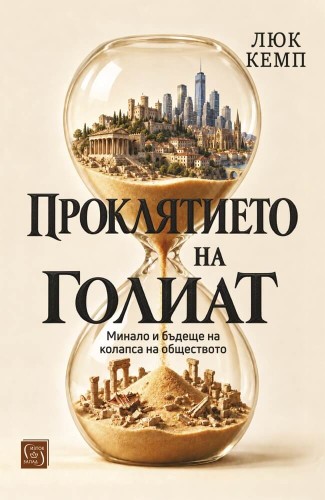
 Interview with Dr Luke Kemp, Author of
“Goliath's Curse”
Why did you choose Goliath as your central metaphor rather than Samson – the blinded, betrayed figure who brings down the temple and is buried beneath its ruins?
Goliath is a replacement term for ‘civilization’. That is because the first states and kingdoms of the world are all marked by slavery, inequality, and human sacrifice, and preceded by warfare. They are a transition from egalitarianism to societies where the few dominate the many. The biblical figure of Goliath is an appropriate term since we are talking about large power structures (Goliath was a giant), which use violence (Goliath was a soldier), come from the Bronze Age, and are often surprisingly fragile.
The story of Samson doesn’t fit as a metaphor: Samson was a heroic figure who sacrificed himself in a great act of strength to kill his oppressors.
Beyond optimistic rhetoric, is Goliath's Curse actually breakable, or is collapse structurally inevitable? Don’t our societies just ultimately follow the universal principle of entropy? Driven by an innate desire for security, humans create systems that endure for a time, yet doesn’t every system eventually drift towards disorder and chaos, making its collapse only a matter of time?
No, entropy didn’t play a role in the collapse of Rome, or the Han Dynasty, or Cahokia, or the Maya. It is a law of thermodynamics not politics, meaning each collapse should be final, rather than entropy restarting with a new polity. Entropy also can’t explain the huge variation we see in the lifespan of states, from the 14-year Qin Dynasty to the Byzantine Empire which lasted around a millennia.
If collapse has clear political roots –such as growing wealth inequality and power concentration– then there are ways to avoid it. They won’t be easy or likely, but it is possible.
As readers will discover in Goliath’s Curse, kingdoms and empires were not created due to a rational desire for security. That is an outdated myth. Instead, the creation and collapse of states is better understood as a story of organised crime.
Across the hundreds of cases you studied, which historical collapse most closely resembles today’s global system, and why?
The Late Bronze Age is the most likely candidate since it was a world of interdependent empires and kingdoms –such as the Old Egyptian Kingdom, the Assyrian Empire, the Kassites, and the Mycenaean– who were closely connected diplomatically and economically. Bronze, which the age was named after, was an alloy of tin and copper which were traded intensely across the societies. Like today, they faced a series of different shocks, including war, a drought, rebellion, a series of Earthquakes, and perhaps even drought, which destabilised the entire network. Their interdependence became a liability. That said, there are lessons that can be learned from different cases studies: colonisation and the collapses that it created can help show the making of the modern world, while Rome is a paradigmatic example of how growing wealth inequality (and concentration of power) causes collapse.
Could the next collapse be so fast and so global that societies would have no time to adapt or reorganize?
Yes, potentially. If there is a global thermonuclear war tomorrow, impacts stretching across the world, including atomic blasts, would play out over a day, and drops in global temperature of 8-10°C within weeks. Similarly, a global cyberattack from more powerful future AI agents could hypothetically paralyse energy grids across the world and the internet. The world and the threats we face have sped up dramatically.
While there is no scholarly consensus that, for example, the Maya civilisation collapsed because they performed too many human sacrifices, many historians argue that sacrifice was not the root cause of the crisis but rather one of its symptoms – during periods of upheaval, rulers may have intensified ritual practices, including sacrifices, in an attempt to appease the gods and restore rainfall, stability, or political legitimacy. Is there a universal symptom that heralds an impending crisis? Are there warning signs that repeatedly appear across societies on the brink of collapse?
There are a set of symptoms that warn of an impending crisis or collapse. These include growing inequality, corruption, socio-political violence, a slower recovery of shocks, and elite capture of the state. These are all the warning signs that a society is becoming more unequal, extractive and vulnerable. We see these across a range of cases, from the first farmers of North America though to some of the largest historical empires such as the Western Roman Empire and the Han Dynasty. Tellingly, they are symptoms we see on the rise today.
On a side note, the Maya were not particularly prolific with human sacrifice. Others, such as the Aztec were far worse. Human sacrifice is instead common across early states: it is a way of cementing power and authority through an act of public brutality.
A few years ago, we witnessed a pandemic that shook and reshaped every sphere of social life; yet these days we find ourselves wondering whether we should be concerned about a possible plague leak from a laboratory in Russia. In recent months, the war in the Middle East has shown just how fragile the global economy is and how deeply dependent it remains on oil; yet Western civilisation seems to continue turning a blind eye to just how dependent it is on resources it does not possess itself. Are we losing the ability to learn from crises?
I’m not sure if we have ever had an enduring ability to learn from crisis. Governments have always tended to be myopic and lessons are usually only taken shortly after a crisis (such as the advent of the EU and reform the constitution in the wake of World War II). This doesn’t need to be the case. We both can develop the ability to learn, and findings from history, archaeology, and anthropology, are giving us better, more scientific lessons.
Don’t you think that the civic energy in democratic societies today has already been exhausted? That what we see now is fatigue and resignation – and that only external crises can bring about real change in the status quo?
No, and this varies dramatically across country. There is no shortage of energy for protest in places such as France and many areas of the US. My bigger concern is the growing power of mass surveillance systems and autocracy to quash political dissent. We can’t rely just on external crisis: a crisis still needs groups to make use of it for the betterment of society. The creation of welfare states and the expansion of the vote wasn’t just due to World Wars or the crises caused by industrialisation, it was also due to the tireless efforts of unions and suffragettes.
Evolutionary biology suggests that abrupt and drastic changes in the environment can trigger evolutionary leaps. Given the avalanche‑like acceleration of modern technologies, is it possible that we might see a break in the familiar pattern by which societies develop – and eventually collapse?
It might, depending on what the technologies are and how they are deployed. To date, technologies have failed to radically transform many of the basic drivers behind societies. Industrialisation was an abrupt and drastic change, but the societies it initially produced weren’t fundamentally different to the preceding empires: they were unequal and built on domination. It took the world wars and large scale social movements to see the rise of welfare-focused liberal democracies.
Today the most important accelerating technology, AI, it set to simply supercharge the basic trends in societies by amplifying inequality, concentrating power, and allowing for greater mass surveillance and control. It is more likely to look a return to the polities of old, rather than a evolutionary transformation.
That is, unless AI simply wipes us out and replaces us: a leap which very few of us outside of Silicon Valley want.
Which book do you wish you had written – both on a personal level and in terms of your professional aspirations?
The book I wrote was the one I wish I had, both personally and professionally. The only other book I deeply want to write is the one I am working on now, on the history and future of mass surveillance.
Interview by Vladimir Tsankov
Products related to this post
Comments