
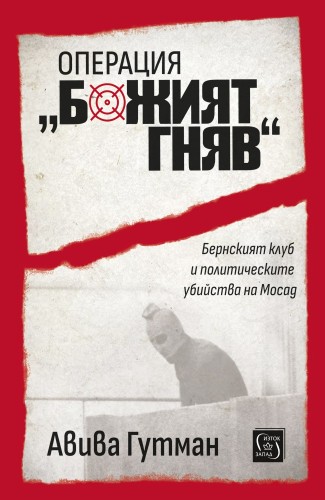
Operation “Wrath of God” – One of the Most Carefully Guarded Secrets of Mossad
 Interview
with Dr. Aviva Guttmann, author and specialist in international security and
intelligence history
Interview
with Dr. Aviva Guttmann, author and specialist in international security and
intelligence history
Mossad often inspires both fear and
respect among Israel’s adversaries. But what emotions do you think it evokes in
the authors who dare to write about its covert operations?
It is true that the image of Mossad is often presented
as a near omnipotent and omniscient agency. What my book does is demystifying some of this aura of
invincibility, as it highlights that Mossad did not (and could not) act alone.
The Israelis relied heavily on European support for the organisation of the
assassinations.
This offers a much more nuanced and realistic view of Mossad’s strength
and weaknesses.
Your book reveals unprecedented
collaboration between European intelligence services and Mossad. What was the
single most surprising form of cooperation you uncovered in the archives?
A surprising case
I find is the murder of Mohamed Boudia, where I have been able to trace in detail
how European intelligence agencies provided the granular details that allowed
Mossad to plan and carry out the assassination.
European
information that was crucial for Mossad included:
- Information
about Boudia’s daily routine (which is important when deciding his “weak point”
and how and where to strike),
- His
cover names when he travelled (he used “Roland Bertin” most frequently)
- Details
and interrogation reports of his contacts in Geneva, Paris, and Vienna,
- Addresses in Paris of himself, and of his (many) girlfriends
- And crucially, details about the car he was driving and that the car was in the name of his former wife (and her address in Paris was also shared).
Mossad was then
able to use these pieces of information and decided that his “weak point” was
precisely his car – the Renault R16 that he loved so much and used daily.
Boudia knew that he was being followed by intelligence agencies and often
changed his appearance (including disguising as a woman to avoid detection).
But even with the best makeup, he would always return to his car, and this is
where Mossad struck indeed: through a car bomb in Paris, 28 June 1973.
In your view, where did European
governments draw the ethical line – and where did they knowingly cross it – in
supporting targeted killings on their soil?
The book
demonstrates clearly a European complicity in Mossad assassinations. European intelligence
was useful for Operation Wrath of God in three main ways.
First, through the
Club de Berne, Israel received help from European agencies in identifying the
Palestinians responsible for or involved in the planning or execution of the
Munich massacre. This was important for Mossad because
every killing operation had to be justified to Prime Minister Golda Meir and a
Palestinians’ involvement in Munich was a clear reason to put someone on the
kill list.
Second, Mossad
received valuable intelligence on the whereabouts and movement of Palestinian
suspects, some of whom had been on Mossad’s kill list. European partners helped
Mossad locate terrorist suspects, initially without knowing that they were
going to be killed. Israel thus received help in the planning and organisation
of their killing operations. In other words, the European intelligence agencies
helped with the groundwork to trace the alleged terrorists on Israel’s death
list.
Third, and most
importantly, after every assassination in Europe, the respective intelligence
agencies would report to the Club de Berne about the case, share detailed
police reports, and regularly provide updates about the ongoing criminal
investigations. This provided Mossad with very clear indications as to whether
the European authorities had any suspicions that Israel might have been behind
the murder. This was also a form of strategic signalling to Mossad. By
continuing to update Mossad about these investigations, European intelligence
signalled that they would not investigate the murder cases further and hinted
that they would let Israel continue its covert operations on European soil.
Even if not necessarily approving, European governments secretly agreed to
tolerate Mossad’s bloodbath in the streets of Europe.
After studying the operation in depth, do
you think the assassination campaign achieved its strategic goals, or did it
create more long‑term instability than it solved?
In my conclusions
I indeed address this question and ask to what extent the operation achieved
its operational, tactical, and strategic goals. On an entirely operational and
organisational level, at least until the Lillehammer blunder, Operation Wrath
of God was a resounding success. Mossad managed to organise “clean kills”
without harming any bystander. Mossad was also able to leave each crime scene
without incriminating evidence, all the while sending a loud and clear message
to Palestinian terrorism supporters that anyone could be hit next, anywhere in
the world.
In this vein, did
Operation Wrath of God achieve its medium-term goal of deterrence? It certainly
instilled fear among Palestinian terrorist leaders and forced them to go
undercover. Mossad’s actions also made it more difficult for them to organise
or support terrorist actions in Europe. For some, this motivated them to fight
Israel even harder, but for many this was indeed a deterrence. Furthermore, on
an operational level, some of Mossad’s assassinations directly prevented
imminent attacks or disrupted planned terrorist operations. Examples of this
are the killing of Khair in Cyprus and Operation Wrath of God’s 7th
killing in Rome, where terrorists were literally on their way to plant a bomb
at an El-Al offices in Rome.
On a tactical
level, a major Operation Wrath of God goal was to wipe out Black September
terrorism in Europe. Indeed, once the covert action ended, Black September was
almost entirely dissolved. However, historians of the Palestinian armed
struggle invite us to be careful with attributing this development entirely to
Mossad. Around the time that Operation Wrath of God slowed down, in late 1973,
inner-Palestinian shifts occurred, and rifts built up between various factions.
Two opposing views emerged about the use of international
terrorism: by late 1973 and early 1974, Fatah’s core leadership under Yasser
Arafat opposed terrorism as a tactic. Its assumption was that efforts to obtain diplomatic
recognition and government support would be more fruitful to secure subsidies,
territorial bases, and diplomatic success.
For Black September this meant that core Palestinian
leadership, including its umbrella organisation Fatah, gradually began to
withdraw support for its terrorist actions.
By the same token,
Operation Wrath of God played its part too as it made it a lot more difficult
for Palestinian terrorists to operate in Europe. Every Palestinian leader had
to live in fear for his life. One can thus conclude that Black September ended
because of a number of factors, including inner-Palestinian tactical changes,
diminishing public support for its actions, and Mossad eliminating its
leadership and operatives in Europe and the Middle East.
But, the picture
looks differently on the longer-term strategic level, asking the question where
does Operation Wrath of God sit in the history of the Arab-Israel conflict?
Some Mossad analysts argue that Operation Wrath of God consumed far too many
resources for little more than vengeance. Money and resources were redirected
from other priorities, including collecting intelligence about its neighbours.
Equally, some authors see Operation Wrath of God as a distraction, which
deflected attention from Israel’s military enemies
like Egypt and Syria. Around the same time as Operation Wrath of God was running,
these countries were planning the Yom Kippur War that indeed caught the Israeli
security establishment by surprise. One can thus argue that with Operation
Wrath of God, Israeli security was pouring too many resources into killing
terrorists when their attention should have been on Israel’s neighbouring
countries. Egypt and Syria were planning and executing actual military attacks
in 1973, which were a lot more threatening than Black September ever could be.
Another unintended
negative effect of Operation Wrath of God was that it gave Mossad a dangerous sense of invincibility and
overconfidence. This led to reckless operational planning and backfired
dramatically with the Lillehammer affair. This international embarrassment had
damaging effects on the agency’s morale, public image, and global reputation.
Looking at the Palestinian armed struggle over the long term, Operation
Wrath of God had relatively minor effects. Mossad’s secret assassinations did
not eradicate Palestinian terrorism in Europe or elsewhere. While Black September terrorism ended, Palestinian
terrorism in Europe reappeared in the next decades in a different form; for
instance, in the 1980s the Abu Nidal group was a
particularly violent branch that again operated in Europe.
Overall, Operation Wrath of God achieved its short-term operational and tactical goals but strategically did not solve any deeper issues nor did it in any way bring Israel closer to peace.
In the course of your research, did you
come across information that you simply could not publish – either for legal,
ethical, or security‑related reasons – and how long do you believe it will take
before such material can be safely disclosed?
No, none. I was extremely pleased that I received
unrestricted, unprecedented, and uncensored access to all the archival material,
which is rare!
Mossad is often described as operating
with a unique blend of audacity and precision. What do you see as the core
strategic doctrine that truly sets it apart from other intelligence services?
I don’t see a
specific doctrine that sets it apart, but what I see is a difference in
capacities in offensive and defensive intelligence. Mossad is extremely strong
in offensive work: it masters precision strikes, assassinations, elaborate
covert operations that are planned sometimes for decades. However, this is in
stark contrast to some crucial mistakes made in assessments of its enemies: for
instance it drastically misinterpreted the threat posed by Hamas in 2023 both
in terms of its capacities to launch the 7 October attack and its intentions.
In short, Mossad
is very strong in offensive covert operations, but weaker in analysing its
adversaries and in organising adequate defensive measures.
Mossad is known for several legendary
operations, from the capture of Adolf Eichmann to the sabotage of Iran’s nuclear
program. In your view, which of these stands out as the most complex and
demanding in terms of planning, risk, and geopolitical consequences – and what
makes it uniquely challenging to study from a historian’s perspective?
Covert operations are among the most difficult topics
to study. The extreme secrecy required for the success of an operation makes it
so that very little information is being given to people outside of an
intelligence agency, sometimes information might not even go beyond the team in
charge of the operation.
This is why the sources that I have found for the book
are so exceptional: they reveal the sources and methods used by Mossad for its
assassinations. These are among the most carefully guarded secrets in the
world, and the book is based on thousands of documents coming directly from
Mossad and the Kilowatt partner agencies!
Interview by Vladimir Tsankov
Products related to this post
Comments