
“The Evolution of Civilizations” by Carroll Quigley and the Contemporary World
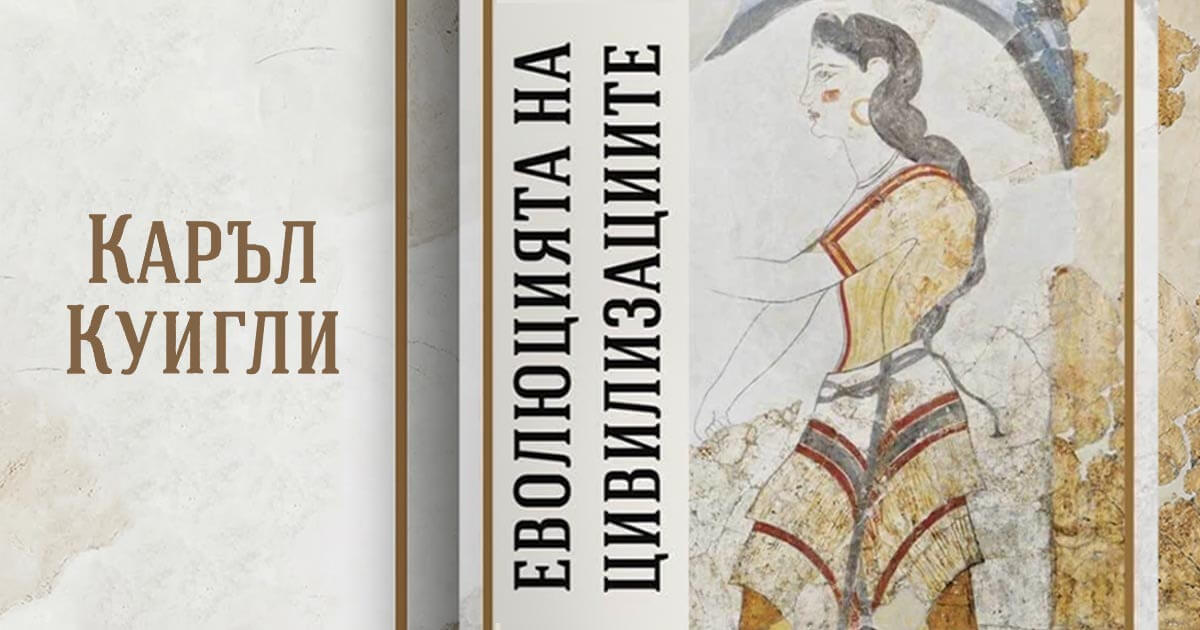
Carroll Quigley’s The Evolution of Civilizations is not merely an extensive historical study; it is a comprehensive theory of the development of human societies. In this sense, the book stands closer to the philosophy of history than to traditional historiography, and it demands from the reader not just attention, but active thought. It is certainly not an ordinary book – it would not be an exaggeration to call it an intellectual beacon in the vast ocean of historical facts, one that helps us understand not only the past but also the relentless mechanisms shaping our present.
The name of Carroll Quigley (1910–1977) is emblematic for readers with an affinity for history, sociology, and erudite analyses of both the past and the modern world: a highly respected professor at the School of Foreign Service at Georgetown University and a legendary lecturer at Princeton and Harvard. The Evolution of Civilizations is an indispensable tool for understanding the complexity of human development. In an age when history is often taught as a fragmented sequence of accidental events, Quigley offers something radically different: a coherent, rational analytical framework that brings meaning to the apparent chaos of events from the dawn of humanity to the present day. The book is a rare phenomenon in historiography – it not only provides facts but also teaches the reader how to think about them.
At the very beginning, Quigley introduces one of his central ambitions: to identify the recurring patterns in the development of civilizations. Instead of viewing history as a chaotic succession of events, he proposes a structured framework in which every civilization passes through a set of defined stages. These seven stages of historical change – mixture, gestation, expansion, conflict, universal empire, decay, and invasion – appear across all civilizations. It is important to emphasize that Quigley does not treat this process as mechanical or predetermined, but as the result of the interaction between ideas, institutions, and social energy.
One of the most essential threads in The Evolution of Civilizations is its comparative approach. Carroll Quigley does not limit himself to analyzing a single civilization in isolation; he places each one within a broad context where different societies, separated by time and space, begin to “speak” to one another through the similarities in their development.
Quigley examines five major civilizations – the Mesopotamian, the Canaanite, the Minoan, the Classical, and the Western — not as unique and unrepeatable phenomena, but as variations of a deeper underlying pattern. This does not mean he denies their individuality or the distinctive features that give each its value; on the contrary, he carefully acknowledges their differences in culture, religion, and social structure. Yet beneath this surface he identifies recurring mechanisms: emergence through innovation, expansion through effective instruments, stagnation through institutionalization, and finally – exhaustion and decline.
A central place in the book is occupied by Quigley’s distinction between “instruments” and “institutions” – a theme he returns to repeatedly, because it is essential for understanding how a social system shifts from being viable to becoming rigid. In the early stage of every civilization, instruments are created: flexible structures designed to meet real social needs and to support the development and advancement of society. These may include economic systems, religious practices, or political forms of governance. Over time, however, these instruments tend to ossify and transform into institutions: self‑contained structures that begin to exist for their own sake. It is precisely at this point, Quigley argues, that social stagnation begins.
When institutions cease to serve society, they begin to block innovation, suppress creative energy, and halt development. As a result, a civilization loses its capacity for expansion – not only territorial, but also intellectual and spiritual. In this sense, “expansion” in Quigley’s framework does not simply mean conquest; it refers to the ability to grow, adapt, and generate new evolutionary mechanisms.
Quigley insists that the fate of any civilization is determined not so much by external events as by its internal capacity to create and maintain the mechanisms of development. In the beginning, these mechanisms are flexible, created in response to real needs – they release social energy and make growth possible. But over time, they become ends in themselves and demand obedience. Thus, instruments turn into oppressive institutions, and it is this transition that marks the beginning of decline. The true crisis does not occur when a civilization is attacked from the outside, but when it stops developing from within. For this reason, Quigley sees the vitality of a civilization not in the absence of crises, but in the way it responds to them. Real strength does not lie in stability, but in flexibility – in the ability to rethink established patterns, create new solutions, and encourage and allow change. When a society begins to fear the new and cling to familiar structures, it loses precisely the energy needed for evolution. In this way, crisis ceases to be an opportunity for development and becomes the beginning of decline.
In this context, Quigley offers a deeper understanding of decline. He does not associate it primarily with external factors – invasions, catastrophes, or economic collapses – but rather with an internal loss of dynamism. Civilizations, he argues, are not destroyed from the outside; they exhaust themselves from within. This idea is particularly powerful because it shifts attention away from dramatic events and toward the subtler processes of internal disintegration. It is precisely here that the comparison begins to acquire a troubling relevance.
When Quigley describes how early civilizations create flexible structures that stimulate growth and then gradually transform them into self‑serving institutions, the reader inevitably begins to recognize the same process in the modern world. The difference is that this time the observer does not stand outside history – they are part of it. When we apply this logic to modern Western civilization, the picture becomes especially compelling. Quigley does not make direct prophecies, but his model allows us to pose important questions:
- Are the economic and political structures that once served as engines of growth now functioning primarily as self‑preserving institutions?
- Do education, science, and culture still operate as instruments of development, or are they increasingly becoming self‑contained systems?
The comparisons Quigley draws with past civilizations suggest that the most dangerous moment is not the crisis itself, but the appearance of stability. In many of the societies he examines, it is precisely the periods of greatest stability that precede the phase of disintegration. This is the moment when institutions are at their strongest – but also at their least capable of change. Particularly striking is the idea that civilizations do not perceive their own condition. Ancient societies in their golden age did not see themselves as civilizations in decline. On the contrary – it is often in the later stages that a sense of cultural superiority and historical completeness emerges. This psychological dimension makes the comparison even more powerful: it calls into question our own self‑perception.
This is precisely the concept of the “universal empire”: the final phase in the development of a civilization – a period of apparent stability and unity that often conceals deep internal stagnation. The empire creates order, but this order is static; it does not generate new energy but rather preserves the status quo. In this sense, stability turns out not to be a sign of strength, but a symptom of exhaustion.
Quigley’s style is particularly worthy of attention. Although he works with vast material and complex concepts, he writes with clarity and methodical precision. His arguments unfold gradually, with a logical coherence that allows the reader to follow his thought without becoming lost. This makes the book accessible without simplifying it; it remains intellectually challenging and inspires admiration for the breadth of its author’s erudition.
The true value of the book lies not only in its historical analysis, but above all in its role as a tool for thinking. It offers no comfort and no easy solutions. Instead, it offers a perspective – broad, at times even unsettling, but necessary.
We may say that The Evolution of Civilizations is a work that demands time and effort, yet rewards the reader with depth and clarity. The book does not merely explain the past; it provides a framework within which the present can be understood more fully. And perhaps most importantly, it gives the reader the sense that history is not something finished, but a process in which we ourselves are still participating.
Products related to this post

Comments