
How "The New Psychology" Helps Us Better Understand the World Today
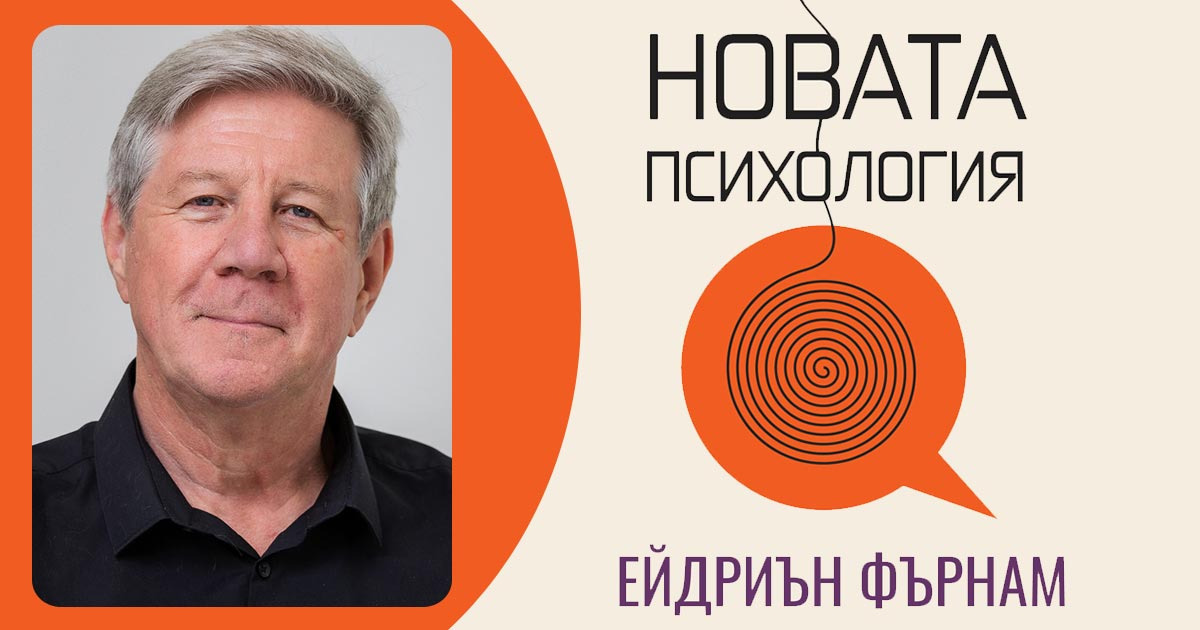 A Conversation with Prof. Adrian Furnham, Author of The New Psychology
Prof. Adrian Furnham is among the most cited contemporary psychologists, a leading researcher in the fields of personality and organizational psychology, and the author of over 90 books and more than 1,200 scientific papers. He teaches at University College London and consults international companies and financial institutions on executive selection, individual differences, and financial behavior. Although his schedule is booked months in advance, Prof. Furnham still found time for a conversation with our team.
As a professor of psychology and a Fellow of the British Psychological Society, he has spent years researching the key factors behind societal mental health and well-being. That is why our conversation begins with one of the most critical questions—why, despite unprecedented access to information, mental health awareness remains insufficient.
"One of the most serious public health challenges continues to be low levels of mental health literacy," he emphasizes.
But what are the psychological traps people can fall into when trying to understand their own mental state? And to what extent is self-diagnosis a reliable tool in the age of artificial intelligence and online tests?
"Knowing oneself, understanding one's strengths and weaknesses, as well as being aware of one's vulnerabilities and capabilities—all of this remains elusive for many people," says Prof. Furnham. "Self-awareness is essential for the success of any therapy. Today, with the help of AI and the internet, one can take all kinds of tests and even receive personal feedback, but not all of them are accurate and many can be highly misleading. That is why both self-assessment and self-diagnosis should always be complemented by the perspective of people who know you and can be honest in their judgment."
However, according to him, the internet poses far more serious risks than inaccurate psychological tests. Social media networks increasingly drag us into a dopamine cycle of instant gratification, where we seek approval through constant digital feedback. Added to this is the well-known psychological mechanism of paying attention primarily to information that aligns with our already established beliefs. Thus, many voluntarily enclose themselves in digital echo chambers where they rarely encounter a different point of view.
"The salvation from such addictive behavior lies in our close friends and family," claims Prof. Furnham. "In the people who are not only able, but also willing to tell you honestly how you look in their eyes. Any therapy is usually painful, but so is the truth—when we realize we are neither as attractive nor as talented as we thought we were. Social media is one of the most addictive and unreliable sources upon which to build our self-esteem."
The topic of social media naturally leads us to another idea addressed in Prof. Furnham's book, The New Psychology: collective anxiety and the way global events shape the overall emotional atmosphere in society. The question is whether the world today is experiencing a similar shared crisis, or if the wars in Ukraine and the Middle East, social conflicts, and economic instability have already become just part of the daily media noise?
"You know the golden rule of the media: 'good' news is 'bad' news. That is why the vast majority of their content must consist of such news. Furthermore, every new generation believes that the crises it faces are terrible and unprecedented. But if you take a look at the news from ten, twenty, or even fifty years ago, you will notice that it is almost the same as today's."
Speaking of generations and the way different age groups perceive the world, we cannot help but touch upon Generation Z. It is precisely Gen Z that is most often described as hyper-sensitive, anxious, and struggling to cope with life's challenges.
"Generation Z definitely has deficits in its coping skills," notes Prof. Furnham. "It is more fragile, and stoicism is entirely alien to it simply because that is how it was taught. Its members are often encouraged to focus on their internal problems and pathologies—and sometimes even to celebrate them. Many are proud of their atypical neurocognitive profiles. People of this generation often find themselves unable to handle many of the stressful situations that accompany growing up, and in most cases, they don't even try to do so."
Another topic that invariably accompanies discussions about Generation Z is the debate surrounding the distinction between biological sex and gender identity. For some, this is a fundamental societal issue, while for others, it is an artificially stoked conflict used for political mobilization. We ask Prof. Furnham whether public debate has gone too far when a significant portion of public attention is focused on cases such as whether a male identifying as a female has the right to use the women's restroom.
"This is a very sensitive topic," replies the author. "I have friends who were fired from their universities because they publicly stated their position on this matter. It is never beneficial for a society when debates and research are banned or censored. But what was once simply a biological question has now been co-opted by sociologists and people with their own political agendas. The truth is that the question of sex differences—and the related differences in people's abilities, beliefs, and behaviors—is fundamental and will not disappear; it is simply too important for society."
An equally important topic is the Dark Triad—a psychological model describing three interrelated personality traits: narcissism, Machiavellianism, and psychopathy. These traits often lie at the root of manipulative and toxic behavior, including among individuals in leadership positions.
We ask Prof. Furnham how we can protect ourselves from such individuals. And whether, in striving to understand the mechanisms of manipulation, we risk starting to think like manipulators ourselves?
"We all have a dark side to our personality. I have evaluated the profiles of hundreds of potential leaders, and there is clear evidence of its strong influence on them. Many people are vain and take pleasure in treating others poorly, but the question is to what extent they realize it, as well as how far they are willing to go. The essence is not whether a person is self-absorbed or not, but where exactly to draw the line between healthy self-confidence and pathological narcissism. The key to dealing with such people is to know our own dark side—that way, we can learn how best to manage situations where it dominates in those around us."
And to what extent can we trust our own judgment? According to Prof. Furnham, the psychology of conspiracy theories is one of the fastest-growing areas of modern psychological science. But isn't there a risk of too easily labeling any unusual claim as a 'conspiracy theory'—a reflex that could sometimes work to the benefit of institutions or organizations interested in covering up uncomfortable facts? History knows many cases where governments and corporations have indeed organized covert operations, manipulated information, or concealed the truth.
"There has been a huge surge in research on conspiracy theories: on who believes in them and why; on the fields where they thrive (such as commerce and medicine); and on whether they can be further shaped according to specific needs. I have often said that it is very useful to look at things from the perspective of those who support such theories and to hear their arguments. We are all aware that many institutions do not tell us the whole truth, but there is a very fine line between being a paranoid conspiracy theorist and being a realist who harbors no illusions about the way the world works."
Our conversation concludes with a topic that is increasingly altering science drastically: artificial intelligence. According to Prof. Furnham, modern psychology is moving further away from studying stable personality traits and shifting toward dynamic systems that are constantly changing under the influence of technology, culture, and societal processes. In a world where more and more scientific disciplines use artificial intelligence to model and predict complex processes, the question inevitably arises: can the human psyche—with its irrationality, intuition, and contradictions—really be reduced to algorithms?
"I believe there are four positions one can take regarding the shared future of artificial intelligence and psychology: that of an enthusiast, a skeptic, a cynic, or an ignoramus. I am a skeptic," the author states firmly. "AI can be very useful if you know how to use it, but also if you are aware of its limitations. It does not understand irony and humor (let alone British humor), and it can self-censor to the point of complete inaccuracy on certain sensitive topics. But even as a skeptic, it is clear to me that AI will be—and already is—an immense resource for scientists in all fields."
Article by Vladimir Tzankov
Products related to this post

Comments