
Welcome to the new website of “Iztok-Zapad” – quality books, knowledge, and inspiration all in one place!
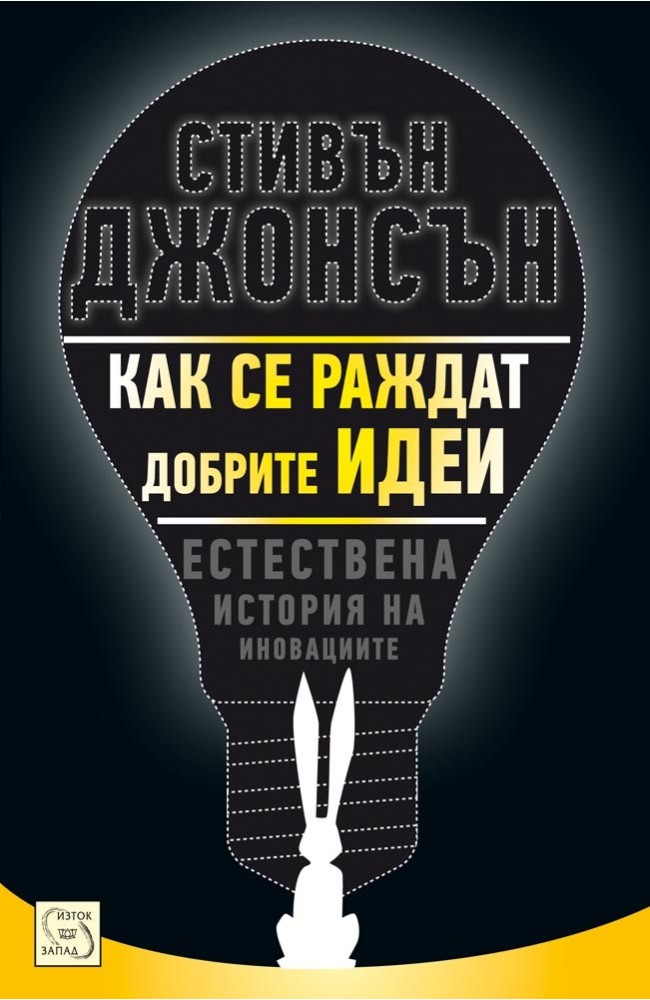
Where Good Ideas Come From: The Natural History of Innovation

Where Good Ideas Come From: The Natural History of Innovation

Sale -20%
  • 8.18€ / 16.00 лв.
  • 6.55€ / 12.80 лв.

Turn the Page. See the World: This month only, enjoy a 20% discount on all books.

Product Code:
762-01
ISBN
978-954-321-934-6
SKU
11.0015
Year
10-02-2012
Translation
From English: Ralitsa Derilova
Pages
288
Size
140/215 мм
Weight
0.36 kg
Cover Type
Paperback
Genre
Scientific Theories, Biology & Evolution, Future & Technology

Steven Johnson

Steven Johnson

Steven Berlin Johnson (born June 6, 1968) is an American popular science author and media theorist. Johnson grew up in Washington, D.C., where he attended St. Albans School. He completed his undergraduate degree at Brown University, where he studied semiotics, a part of the school's modern culture and media department. He also has a graduate degree from Columbia University in English literature. J…

Read more

The printing press, the pencil, the flush toilet, the battery--these are all great ideas. But where do they come from? What kind of environment breeds them? What sparks the flash of brilliance? How do we generate the breakthrough technologies that push forward our lives, our society, our culture? Steven Johnson's answers are revelatory as he identifies the seven key patterns behind genuine innovation, and traces them across time and disciplines. From Darwin and Freud to the halls of Google and Apple, Johnson investigates the innovation hubs throughout modern time and pulls out the approaches and commonalities that seem to appear at moments of originality.

"The figure of the lone genius may captivate us, but we intuit that such geniuses’ creations don’t materialize in a vacuum. Johnson supported the intuition in his biography of eighteenth-century scientist Joseph Priestly (The Invention of Air, 2009) and here explores it from different angles using sets of anecdotes from science and art that underscore some social or informational interaction by an inventor or artist. Assuring readers that he is not engaged in “intellectual tourism,” Johnson recurs to the real-world effects of individuals and organizations operating in a fertile information environment. Citing the development of the Internet and its profusion of applications such as Twitter, the author ascribes its success to “exaptation” and “stacked platforms.” By which he means that curious people used extant stuff or ideas to produce a new bricolage and did so because of their immersion in open networks. With his own lively application of stories about Darwin’s theory of atolls, the failure to thwart 9/11, and musician Miles Davis, Johnson connects with readers promoting hunches and serendipity in themselves and their organizations."

- Gilbert Taylor

There are no reviews for this product.