
Welcome to the new website of “Iztok-Zapad” – quality books, knowledge, and inspiration all in one place!
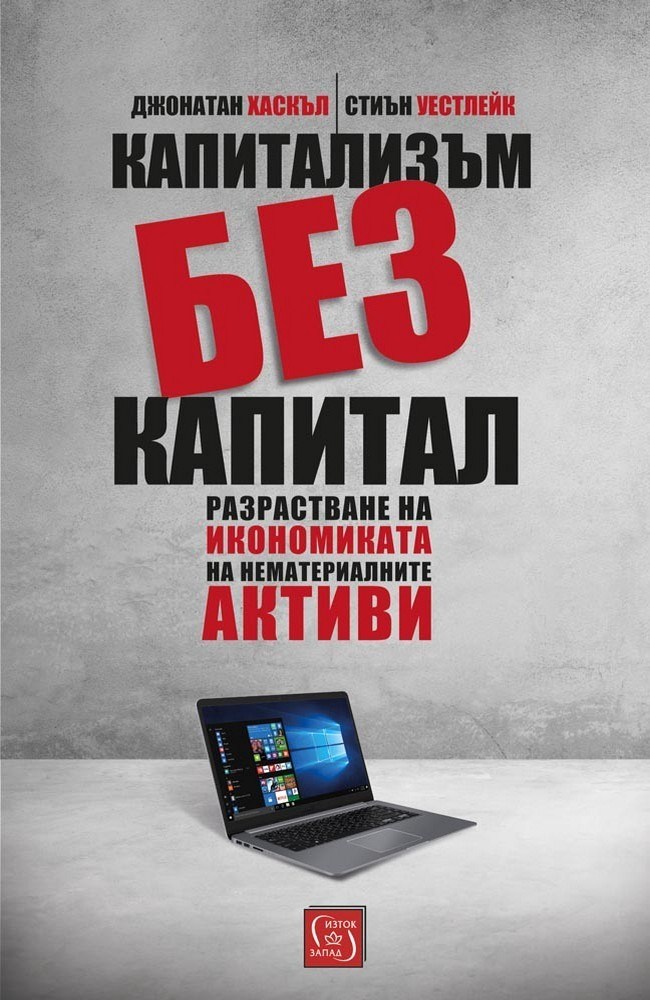
Capitalism Without Capital: The Rise of the Intangible Economy

Capitalism Without Capital: The Rise of the Intangible Economy

Sale -20%
  • 10.23€ / 20.00 лв.
  • 8.18€ / 16.00 лв.

Turn the Page. See the World: This month only, enjoy a 20% discount on all books.

Product Code:
2193-01
ISBN
978-619-01-0309-7
SKU
11.0169
Year
05-09-2018
Translation
from English: Dimitar Stefanov
Pages
352
Size
140/215 мм
Weight
0.49 kg
Cover Type
Paperback
Genre
Business Strategies, Economics, Investments & Entrepreneurship, Capital & Funds, Online Business & Technologies
Jonathan Haskel, Stian Westlake

Jonathan Haskel, Stian Westlake

Jonathan Haskel CBE is a British economist and professor of economics at Imperial College Business School. Prior to joining Imperial College London, Haskel was professor and head of the economics department at the Queen Mary University of London. Haskel has taught at the University of Bristol and London Business School and been a visiting professor at the Tuck School of Business, Dartmouth College…

Read more

The first comprehensive account of the growing dominance of the intangible economy

Early in the twenty-first century, a quiet revolution occurred. For the first time, the major developed economies began to invest more in intangible assets, like design, branding, R&D, and software, than intangible assets, like machinery, buildings, and computers. For all sorts of businesses, from tech firms and pharma companies to coffee shops and gyms, the ability to deploy assets that one can neither see nor touch is increasingly the main source of long-term success.

But this is not just a familiar story of the so-called new economy. Capitalism without Capital shows that the growing importance of intangible assets has also played a role in some of the big economic changes of the last decade. The rise of intangible investment is, Jonathan Haskel and Stian Westlake argue, an underappreciated cause of phenomena from economic inequality to stagnating productivity.

Haskel and Westlake bring together a decade of research on how to measure intangible investment and its impact on national accounts, showing the amount different countries invest in intangibles, how this has changed over time, and the latest thinking on how to assess this. They explore the unusual economic characteristics of an intangible investment, and discuss how these features make an intangible-rich economy fundamentally different from one based on tangibles.

Capitalism without Capital concludes by presenting three possible scenarios for what the future of an intangible world might be like, and by outlining how managers, investors, and policymakers can exploit the characteristics of an intangible age to grow their businesses, portfolios, and economies.

There are no reviews for this product.