
"Every book, every volume... has a soul!"
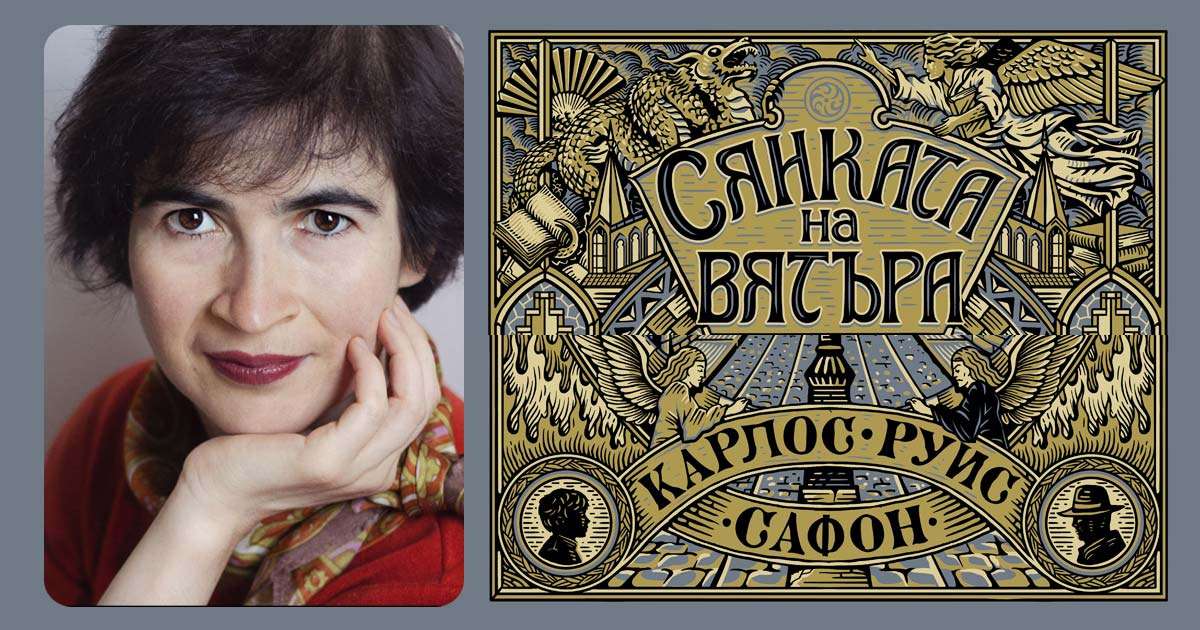
An Interview with Svetla Hristova, Translator of The Shadow of the Wind
You have said that The Shadow of the Wind was perhaps one of your most difficult translations—partly because it was your first encounter with Carlos Ruiz Zafón and it took you time to immerse yourself in the author’s style and characteristic means of expression. Today, having translated all of his major works into Bulgarian, does Zafón still hold secrets from you? And what further aspects of his world revealed themselves to you over the years?
Zafón is an author who loves playing with words; this is evident even in the titles of his works. The Shadow of the Wind immediately captures the reader’s imagination with its peculiar paradox, creating the expectation of a story in which the present and the past are intertwined, and the visible and the invisible coexist. It truly did take me time to ease into the author’s distinctive style, yet I gradually came to know his literary world—the blurred boundaries between reality and fantasy, and the gothic atmosphere that always plays a vital role in his novels. With each subsequent book, something more about the author himself was revealed to me: his particular sensitivity to loneliness and loss, love, fear, and time. I realized ever more clearly how crucial Barcelona is in his universe—not merely as a geographical location, but as a living organism that exists in the narrative alongside the characters. Over time, I grew accustomed to the nuances of his style, though that did not make translating him any easier; the better you know an author, the greater the responsibility you feel toward every single word. One could say that even after all these years, Zafón has not ceased to keep secrets from me—yet it is precisely this sense that we haven't uncovered everything to the very end that keeps drawing us back to an author’s work.
In Zafón’s world, books choose people. What was your personal connection to The Shadow of the Wind, and was there a moment when the book began telling you something about yourself?
I think that sometimes books really do choose their readers, even if we only realize it later. When I first encountered The Shadow of the Wind, I was not yet familiar with Zafón’s world, yet the book drew me in with its atmosphere, its mystery, and that peculiar feeling that behind every door hides another story, and behind every story, yet another. Gradually, however, I came to understand that this book is not merely a riddle to be unraveled. It is also a tale about the very act of reading, about the power of books to change our lives, leave their mark on us, and sometimes help us better understand our own feelings and choices.
I could not point to a single moment when the book told me something about myself. Rather, I gradually discovered the way a single phrase can create an entire world, and a literary image can stay with you long after you have closed the book. They say the translator is the most attentive reader; while working on this text, I was reminded of this once again, as it demanded that I listen closely to it, searching not only for the exact meaning, but for the subtlest nuances.
If you had to tell someone about the magic of The Shadow of the Wind without giving away a single word of the plot, what would you say?
I would tell them that The Shadow of the Wind is one of those books you don’t just step into, you get lost in—and in fact, that is part of the pleasure. This book is for people who believe that books have a soul, that words can change destinies, and that some stories do not end on the final page. Within it, there is mystery, love, and melancholy, dark episodes and immense humanity, as well as an inimitable Barcelona whose atmosphere envelops you from the very first lines. In this book, a gripping plot blends seamlessly with colorful characters whose fates leave no reader indifferent, coming alive in their imagination.
This novel is simultaneously a gothic mystery, a love story, and a literary game. Which of these layers was the hardest to convey into Bulgarian, and why? And how did you resist the temptation every translator faces sooner or later—to add something of your own that is missing in the original text?
I believe the hardest part was preserving the atmosphere, because it is born precisely from the layering of all these elements. In a gothic mystery, the rational intertwines with the irrational; a love story demands delicacy and emotional depth; and a literary game requires utmost precision with words, allusions, and hidden references. With Zafón, nothing is accidental, and a single word often carries far more than its immediate meaning.
As for the temptation to add something of one's own, there is hardly a translator who has managed to escape it. Oscar Wilde said, "The only way to get rid of a temptation is to yield to it." Of course, the translator is inevitably present in the text, yet that presence must be subtle. The greatest compliment for a translator is for the reader to forget they are reading a translation and to feel as though the author is speaking directly to them. My task is to find the truest way for the author to resonate in Bulgarian without losing his voice.
The Shadow of the Wind is one of those rare books that readers recommend with almost religious conviction. Did you sense that you were holding a future literary phenomenon in your hands while translating it? And where do you see its place on the world literary stage 25 years after its publication?
I wouldn’t say I foresaw the level of success the book would achieve. When translating a novel, you are focused above all on the text itself—on its world, language, rhythm, and the challenges it sets before you. Yet even then, I felt that The Shadow of the Wind possessed something extraordinary—the rare ability to captivate the reader, creating the sensation that you have stumbled upon a story written personally for you.
After all these years, I believe the novel has proven its endurance precisely because it transcends its genre definitions. It is at once an engrossing tale, an homage to literature, and a reflection on memory, love, and human destiny. For me, the greatest proof of its place in contemporary literature is that people continue not only to read it, but to gift and recommend it with special affection. It would be no exaggeration to say that it constantly wins new admirers, and interest in it never wanes.
Which of Zafón’s book worlds was the hardest to part with after finishing its translation? And in which other creators today do you continue to discover the author’s legacy?
Perhaps the hardest to part with was The Labyrinth of the Spirits, because it marked the end of my journey through Zafón’s universe. Yet my first encounter with it, The Shadow of the Wind, left a special imprint, as it was both a professional challenge and a true literary adventure. In fact, with each subsequent book, I felt I was not leaving that universe behind, but merely discovering new dimensions of it.
As for Zafón’s literary legacy, I think it can hardly be reduced to specific names or direct influence. Rather, I would look for it in those contemporary authors who know how to combine genre storytelling with psychological depth, creating a potent atmosphere and vivid, memorable characters. Yet Zafón possesses something truly distinctive—a love for books, for Barcelona, and for stories that intertwine and continue to live within one another. In time, imitators will surely appear, yet Zafón’s world will lose none of its enchantment because of it.
Many describe Carlos Ruiz Zafón’s work as a meeting point between Umberto Eco, Gabriel García Márquez, and Jorge Luis Borges. You have also translated Borges—where do you find the most striking parallels between these two authors?
I think the most striking similarity between Borges and Zafón lies in their attitude toward literature itself—for both of them, books are not merely objects or stories, but entire universes in which one can lose oneself, discover oneself, and stumble upon unexpected truths.
Borges typically presents this through the philosophical riddle, the labyrinth, the library, and the play with time and infinity. In Zafón, these motifs take on a more romantic and emotional dimension. His labyrinths are not only intellectual, but deeply human—built out of memories, secrets, and feelings.
As a translator of both, I find something else in common—an extraordinary attention to words and to the multi-layered nature of the text. Yet while Borges often makes us contemplate the infinity of the world and of literature (here we might mention "The Library of Babel" and "The Book of Sand"), Zafón shows us the profound impact books can have on our personal lives.
Perhaps therein lies their closest kinship: both remind us that reading is not merely a passive pastime, but an encounter capable of transforming our worldview.
Without giving away too much of the plot of The Shadow of the Wind, the Cemetery of Forgotten Books is one of the most magnetic places in contemporary literature. If you could hide just one book there for future generations to discover, which one would it be and why?
If I had to hide just one book in the Cemetery of Forgotten Books, I would perhaps choose the collection containing the surviving works of Epicurus. Of all the ancient philosophers, he has likely remained the most misunderstood; his name has become a byword for a lifestyle the very opposite of what he actually preached.
I would want future generations to discover him because his philosophy consists of a happy and tranquil existence free from fear and pain, which can be achieved by cultivating moderation, friendship, shedding one's fears, and self-knowledge.
Incidentally, the Cemetery of Forgotten Books, as Zafón himself points out, is a place meant to shelter not only great masterpieces. There must also be books that were once loved by a single person—for that alone is reason enough for a book to deserve salvation.
In addition to being a translator, you are also a painter and illustrator. If you had to liken Zafón to a painter, what kind of artist would he be? From which movement and which era?
If I had to liken Zafón to a painter, I would probably associate him with the Pre-Raphaelite Brotherhood, which emerged in England in the mid-19th century. This movement was founded by young artists united by their interest in the aesthetics of the Middle Ages, International Gothic, and the works of Early Italian Renaissance painters.
Zafón, however, would add something of his own to such painting—literary magic. His canvases would not merely catch the eye; they would invite the viewer to invent stories about whatever remains hidden.
Do you have a favorite quote from The Shadow of the Wind that you still remember by heart today?
It is difficult to single out just one quote, though I would probably choose the one that concisely expresses one of the central motifs in Zafón’s work: "Every book, every volume you see here, has a soul. The soul of the person who wrote it and of those who read it and lived and dreamed with it."
Interview by Vladimir Tsankov
Products related to this post
Comments